Kaiser Permanente and the Alliance of Health Care Unions

Program-wide

The View From the High Road

Deck: 
Our 20-year partnership journey

Story body part 1: 

Where were you 20 years ago? The three of us were each on a different path—paths that crossed in unexpected ways, and changed the way we do our jobs.

Our Labor Management Partnership often is described as a journey, for good reason. It is ever changing. It can be difficult. And you never know where it’s going to take you next. But it also has a few rules of the road that help us find our way:

Understand and respect one another’s needs and interests. Listen openly and assume the best intentions of your counterparts. Ask questions, especially, “Why?” Create an environment where people feel safe speaking up.

Over the years, that approach has gotten positive outcomes for Kaiser Permanente, our unions, our workforce and, most important of all, our members and patients.

That doesn’t mean our partnership is perfect; it isn’t. Or that we always agree; we don’t. But we’ve tried the traditional ways of working, and the trip is much better on the high road that Kaiser Permanente and the Coalition of Kaiser Permanente Unions have chosen.

Thank you for your hard work and dedication. We invite you to join colleagues in your unit, department or region this fall to celebrate your accomplishments, reflect on our challenges, and commit to creating an even better future.

TOOLS

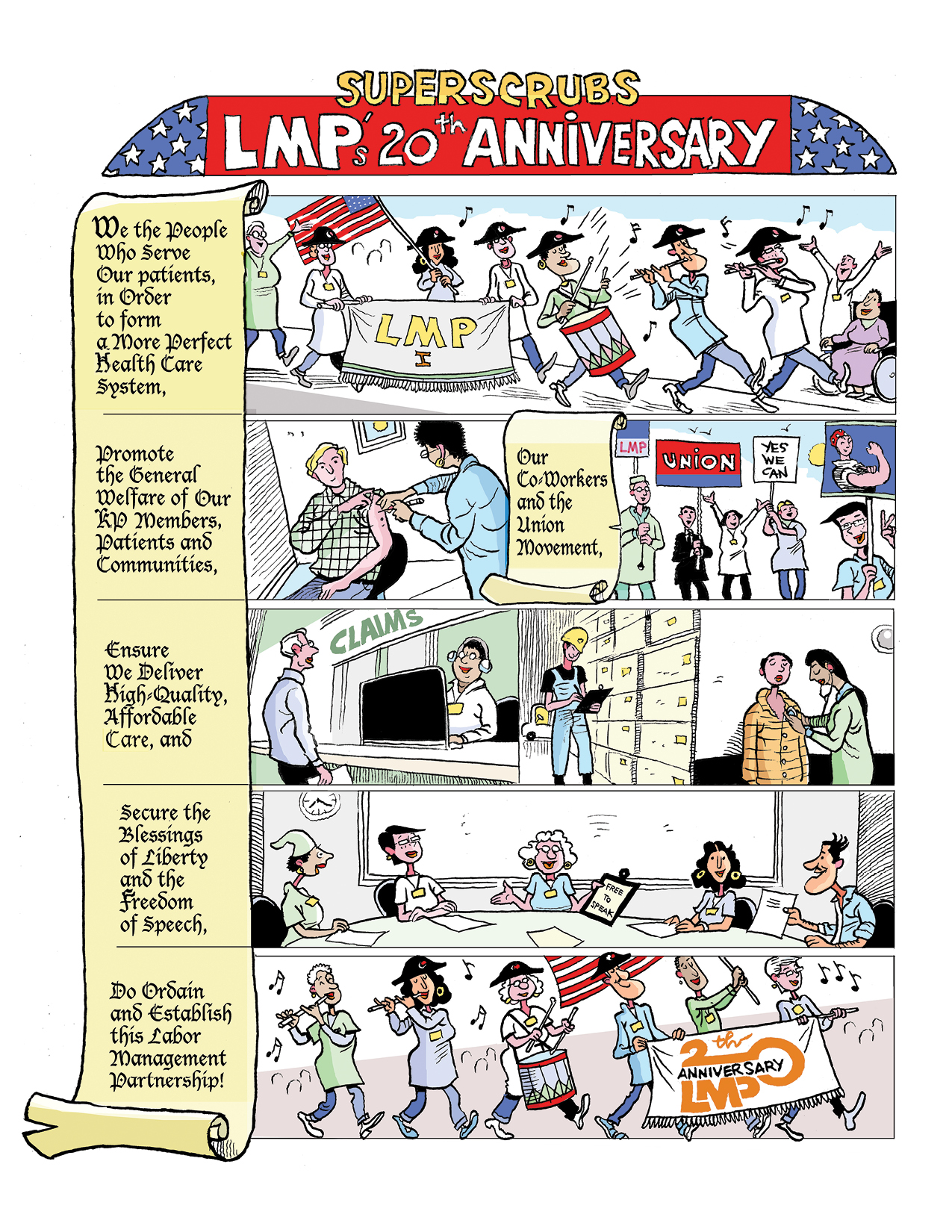
SuperScrubs: LMP's 20th Anniversary

Format:
PDF (color or black and white)

Size:
8.5" x 11"

Intended audience:
Frontline employees, managers and physicians, as well as anyone with a sense of humor. 

Best used:
Post on bulletin boards to help celebrate the 20th anniversary of the Labor Management Partnership. 

Related tools:

Partnership Beats the Odds

Deck: 
Kaiser Permanente and Coalition of KP Unions celebrate 20 years of partnership

Story body part 1: 

Forty percent of U.S. marriages end in divorce after an average of eight years. Most business partnerships fail to meet expectations. And most campaigns end when they achieve their goals or the world moves on.

But the Labor Management Partnership between Kaiser Permanente and the Coalition of Kaiser Permanente Unions has beaten the odds: October 2017 marks the 20th anniversary of the partnership’s founding, making it by far the largest, longest-running and most sweeping such partnership in the country.

We’ve accomplished a lot together. And in a world of change, sustaining a healthy long-term relationship is an achievement in itself. A key to our success has been the willingess to honestly reflect on our successes, failures, and opportunities to improve. 

By working in partnership, says Kaiser Permanente Chairman and CEO Bernard Tyson, “We have tapped into the potential of smart people all over the organization coming here every single day trying to figure out, ‘How do I improve quality, how do I improve service, how do I improve affordability?’ That’s an incredible competitive advantage for the organization.”

Marking a milestone

This fall Kaiser Permanente and the union coalition will be celebrating those achievements with special events and employee outreach. It won’t be all cake and balloons, however. LMP regional councils, unit-based team sponsors and co-leads, and others will host reflection sessions where workers, managers and physicians can share their experiences, pain points and suggestions for the future of partnership. Participants will consider three questions:

  • What is different since we created partnership? (Or, what do you see as the top accomplishments of partnership?)
  • What are the greatest challenges it faces today?
  • How might we address those challenges, to strengthen partnership now and in the future?

Getting results

Partnership is not easy, and the parties don’t always agree on things. So what’s kept it going?

“It’s nice if we can all get along,” says Tyson. “But most important, we’re here to get results.” Here are some of the results achieved in partnership:

  • Performance improvement: More than 50,000 team-led improvement projects since 2007, with measurable gains in quality, service, the work environment—and cost savings exceeding $48 million in 2016.
  • Best place to work: Industry-leading wages and benefits, a voice in decision making, and an Employment and Income Security Agreement providing retraining and redeployment for displaced workers.
  • Joint marketing: Strategic engagement brought strong gains in KP membership, union coalition membership, and more than $108 million in revenue for Kaiser Permanente in 2016.
  • Job training and career advancement: More than 300,000 professional, academic and skill-enhancement courses taken by 104,000 coalition-represented employees since 2007.
  • Systems collaboration: Joint implemention of multiple complex programs and systems, including KP HealthConnect, Claims Connect, ICD-10 and call center reorganization.

Lessons for success

All of the above have garnered attention from business, union and academic leaders over the years.

“The Labor Management Partnership is a shining example of how you bring labor and management together to produce results,” said Liz Shuler, secretary-treasurer of the AFL-CIO. “What I love about this model is the notion that, no matter where you work in the system, you have a place at the table and your voice is heard.”

Working in partnership also holds lessons that apply outside of work—including lessons that might have saved some of those failed marriages.

“If you are going to be a good partner and have a successful relationship, with a partner, kids, friends,” says a facilitator from 2015 national bargaining, “you have to have your partner’s needs in mind as well as your own.”

To learn more about LMP anniversary activities, visit the 20th Anniversary How-to Guide.
Engaged Teams Build Communities

Deck: 
Three new ways to get involved

Story body part 1: 

Health care workers, their managers and physicians care for others every day. And it doesn’t stop at the doors of our facilities.

On Martin Luther King Day this past January, 5,600 Kaiser Permanente employee volunteers took a “day on” to refurbish schools, staff food kitchens and work in more than 150 other projects in the communities we serve.

Helping others—and ourselves

More than 14,000 KP employees signed up for the Pound for Pound Challenge in the first three months of 2017. The program donated a pound of food to local food banks for every pound that participants lost in those months. The result: 72,893 pounds of food donated to our communities—enough to provide more than 60,000 meals.

Teams and regions have put their own stamp on this campaign. For example, Colorado organized a healthy competition for collective weight loss. Other regions reported dramatic, sustained changes in participants’ eating habits and fitness.

Teams step up

Unit-based teams across KP are conducting small tests of change—including social change—by going into the community to address hunger, poverty and other obstacles to total health. Team projects include:

  • In South Sacramento (Northern California), about 100 KP workers from 22 UBTs helped local kids by building and donating bicycles to needy kids in the community—and building teamwork in the process.  
  • KP workers represented by Steelworkers Local 7600 in Fontana (Southern California) helped kick off monthly sponsored food giveaways for needy families in their service area.
  • Baseline Medical Offices’ Primary Care UBT in Colorado assembled Whole Foods Market meals for needy KP members and delivered them in person—a gesture that team members said meant as much to the families as the meals themselves.
  • A call center team in the Northwest region donated more than 400 needed items and $195 in cash to a local camp for children who have or are affected by AIDS.

Commitment to communities

Frontline engagement furthers the social mission of both Kaiser Permanente and the Coalition of Kaiser Permanente Unions, which is why the 2015 National Agreement provided for employees and their unions to work with KP to build strong and healthy communities.

“I was thankful to the team for participating,” says Fernando Gomez, a quality assurance specialist and SEIU-UHW member whose records scanning team participated in the Build a Bike program in South Sacramento. “It was fun and took a lot of teamwork.”

Adds Scan Center Supervisor Rozina Ali, “It was a very positive, moving reminder that we are here to help people. Afterward, a lot of us volunteered to do more.”

Videos

How Our Partnership Came to Be

Loading the player...

(9:19)

The story behind the creation of our Labor Management Partnership, which emerged in 1997 after years of strife between Kaiser Permanente and its unions. Leaders from Kaiser Permanente and some of the key Partnership unions, both past and present, share how they agreed to work collaboratively — a solution that ultimately improved care for members and provided job security for workers. Today, our partnership is the largest and most comprehensive of its kind.


Meet Your National Agreement: Training for Everyone, Starting in the Middle

Deck: 
Building skills among mid-level management and union leaders

Story body part 1: 

“The No. 1 reason for the success of our teams has been personal engagement,” says Alan Kroll, a primary care area administrator in Colorado who co-sponsors nine unit-based teams with his labor and physician partners. “Everyone needs to buy into the process to make partnership work.”

Building engagement and ensuring a consistent work experience have been goals of the Labor Management Partnership since the beginning. But, at the same time, there’s been a good deal of variation around these efforts from location to location across Kaiser Permanente, to the frustration of many managers, workers, and KP members and patients.

That’s why the 2015 National Agreement mandates partnership training for everyone, including the mid-level managers and union leaders who guide others. Early versions of the partnership training for mid-level leaders, which will be available this year, have gotten high marks from UBT sponsors and other leaders who have taken it. 

Consistency counts

The agreement calls for “a learning system that supports sustained behavior change, partnership and performance.” This includes joint training and refresher courses—delivered in-person
and/or online—to “achieve the same partnership and employment experience wherever one works in KP.” 

The new training for mid-level leaders will include segments on: interest-based problem solving examining the forces that support or undermine partnership core partnership behaviors and principles the strategic importance of the LMP 

Joint training is key 

The programs are designed to develop successful leaders who can model partnership and spread successful practices—and to ensure that the managers or union representatives helping teams have what they need to support those teams.

“It is very powerful for managers and union leaders to be in training together,” Kroll says. “It sends the message that everyone is important, and sets a foundation to work from when an issue gets stuck.”

The training served as a reminder that good partnership practices also are good leadership practices. 

“People want to hear from their leaders,” he says, and to “know what issues we are dealing with and that we can help remove obstacles.”

See the 2015 National Agreement, section 1.E, Education and Training (pages 31–33) for additional information.

TOOLS

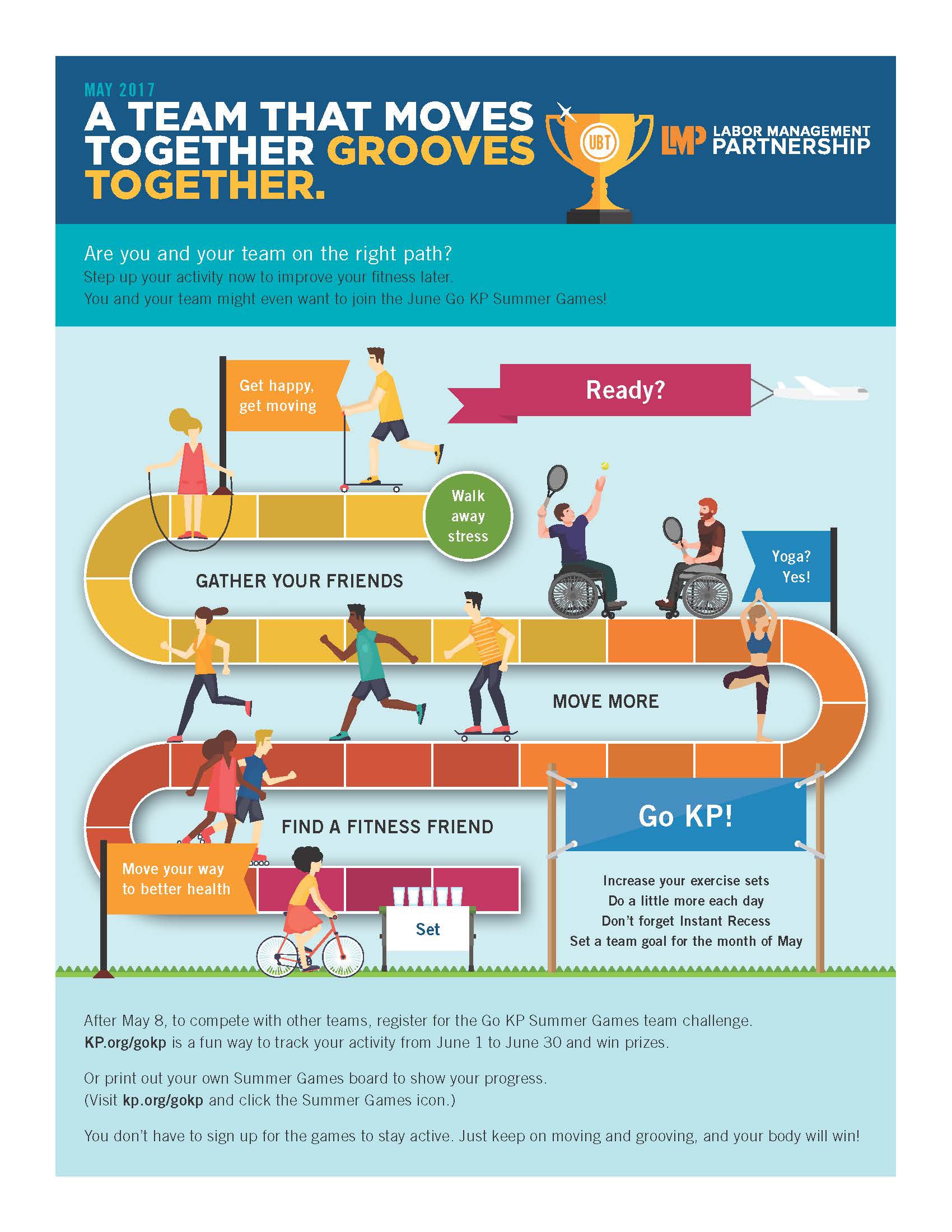
Health and Safety Champions—May 2017 Focus

Format:
PDF

Size:
One page, 8.5" x 11"

Intended audience:
UBT health and safety champions

Best used:
Use this flier to spark ideas and build participation in summer fitness activities.

Related tools:

TOOLS

Unit-Based Teams Are Getting Results: 2017

Format:
PowerPoint

Size:
12 pages, 8.5" x 11"

Intended audience:
Unit-based team members, co-leads, sponsors and consultants; union and KP leaders

Best used: 
Share in presentations or team meetings to see successful practices from UBTs across Kaiser Permanente.

Related tools:

Pages

Subscribe to RSS - Program-wide