Kaiser Permanente and the Alliance of Health Care Unions

Program-wide

TOOLS

Make the Workplace Safer: Computer Users

Format:
PDF

Size:
Five pages, 8.5" x 11"

Intended audience:
Workplace safety co-leads, safety committee members and safety champions

Best used:
This checklist of 32 potential hazards can help workplace safety leaders and workers conduct onsite walk-throughs and identify safety risks for computer users and office staff.

Related tools:

Hair on Fire? There's Hope

Deck: 
Stress and health care work seem to go hand in hand. Here are ways to fix the problem.

Story body part 1: 

Struggling with stress? Got the burnout blues? We’ve all been there. A long line of patients snaking out the pharmacy door; appointments running a half-hour late.

Yet not all things that trigger stress are bad—getting excited before running a race is stressful; so is falling in love.

“A little bit of stress is good,” says Dawn Clark, MD, an ob-gyn specialist and chief facilitator of physician wellness for the Southern California Permanente Medical Group. “It helps you avoid boredom and keeps you engaged and energetic. But too much stress burns you out.”

Unfortunately, the chronic stress that leads to burnout is commonplace in health care. A 2013 survey found nearly 60 percent of health care providers are burned out. A 2015 nationwide poll showed burnout affects nearly half of all physicians.

The result? A burned-out workforce is one with low morale and high rates of absenteeism, turnover and workplace injuries. Inevitably, service and quality of care slip.

This issue of Hank takes a look at the causes of health care stress and burnout—and at the solutions. Read on to find out more about how:

  • Individuals can take steps to handle stress better.
  • Leaders can be role models and make solving workplace stress a priority.
  • Unit-based teams can address the root causes of burnout, finding remedies for lasting change.

Burnout: A widespread problem

Stress is the brain’s response to the demands put on us. Your pulse quickens, your muscles tense and you breathe faster. Everyday stresses are like small flames keeping you on alert. Burnout—which sets in when stress and frustration pile up without getting fixed—is your own personal forest fire.

Your body wears down as the constant flow of stress hormones suppresses your immune system and other functions. You don’t sleep well, and you become edgy, irritable and cynical. You don’t make good decisions. In short, you shut down. Making matters worse, your black cloud is contagious and can quickly spread to your co-workers.

Experts say burnout is usually caused by:

  • inefficient work procedures—and no power to change them
  • no sense of meaning and purpose to your workday
  • lack of work-life balance

In health care, the problem is even more complex. Frontline employees are expected to be selfless and put others’ needs first. But patients may be unhappy or demand answers when there are no easy answers to give. That’s stressful, and even more so when busy schedules are factored in.

UBTs to the rescue

Poorly designed jobs and systems are a leading cause of burnout, which means UBTs have amazing power to improve matters.

Say, for example, overlapping processes make a member-patient feel like she’s getting tossed from department to department. Her justifiable frustration may get unleashed on employees. A UBT provides a forum where an employee can speak up and say: “This process needs to change. What can we do to make the system smoother for the patient?”

That’s what Michael Leiter, an expert on workplace stress, says has to happen to reduce burnout. To fix it, you need to “change something that really matters about how you participate in your job.”

Sometimes the solutions are relatively simple. For members of the Esoteric UBT in the Sherman Way Central Lab in Southern California, working in cold, noisy room that made it hard to concentrate was causing stress—but they worked together and were able to move a key piece of equipment to a more comfortable room.

“Now at the end of the day, it doesn’t feel like I’ve just finished climbing a mountain,” says Gene Usher, one of the team’s research scientists. “It was a UBT success.”

Working together on performance improvement can cure what ails a team, as the Revenue Cycle team at Roseville Medical Center near Sacramento discovered. It also learned—as many teams do—that before it could fix its processes, it had to clear up underlying tensions first.

The team had low People Pulse scores; old conflicts between co-workers had never been resolved. So the team chose to improve its response to the survey question about “having a say in influencing decisions.”

“We decided to do tests of change that involved the staff more,” says management co-lead and former UBT consultant Kimberly Jones.

Team members started working together on improving the annual vacation process—a big morale boost. The 37-member team also took customer service trainings and a Kaiser Permanente Courageous Conversations class, which teaches different ways of approaching conflict and taking responsibility for your actions.

The class “made it easier to approach someone if there was a work problem,” says Stacey Kearny, an admitting representative and SEIU-UHW shop steward. “Now we act more like a team. When we come onto our shift, we ask the person leaving, ‘Is there something I can help you get finished?’”

Meet Your National Agreement: Champions for Health and Safety

Deck: 
By helping create a better workplace, new advocates also help improve patient care

Story body part 1: 

Rotonya Parker decided her journey to a healthier lifestyle could use some traveling companions.

She was already eating better and being more active when she learned that her unit-based team needed a Health and Safety Champion.

“I thought I should volunteer because doing it as a team would be an extra incentive,” says Parker, an external referral coordinator in Atlanta and a member of UFCW Local 1996. Since stepping up, she’s shared healthy recipes with her team and is planning a contest to see who walks the most.

Her activities help her UBT fulfill part of the 2015 National Agreement: The latest Path to Performance requires that Level 1 UBTs identify a Health and Safety Champion, who will help build the “culture of health and safety” required of Level 5 teams.

UBTs began identifying champions last fall. In January, they all received “Walk & Roll” buttons to help encourage their colleagues. They got going with an emphasis on walking and moving. In February, the theme was speaking up at work about safety concerns. Each month has a new focus.

With 32 years at Kaiser Permanente in Los Angeles under his belt, Darren “Tree” Wallace, a lead attendant in environmental services (EVS), offered to be his UBT’s champion. EVS departments frequently have a higher rate of workplace injuries, Wallace notes, so safety is key. Members of his UBT share daily tips about everything from how to avoid needle sticks to the proper way to push and pull.

“You don’t want to be old, retired and injured,” says Wallace, a member of SEIU-UHW. “You have to make sure your body is safe at work and at home.”

Take a break to thrive

For Johnyia King Turner, RN, a UFCW Local 400 member in the Mid-Atlantic States, volunteering to help her UBT as a champion was an obvious choice. Turner, who recently began working in Gastroenterology at Largo Medical Center in Maryland, frequently held two-minute thrive breaks when she worked at Capitol Hill Medical Center in Washington, D.C.

“We did squats, wall push-ups or ran in place,” Turner says. As lead nurse, she also presented safety messages in UBT meetings and paused during the workday to have quick safety conversations.

She says the messages were well received: “If you are not healthy and you are not safe, it decreases productivity and we can’t assist the members.” 

She’s excited to have a formal title to go with her passion. “I have my Walk & Roll button, and I encourage everyone to walk the stairs,” she says—and adds, laughing, “Now that I’m official, I can really go run my mouth and tell people what they need.”

From the Desk of Henrietta: Relieve Stress With ‘Yes, and’

Story body part 1: 

The chances are good you are a person who deals—directly or indirectly—with life and death every day. You might be an EVS worker who keeps patient rooms germ-free to reduce the odds of infection, or an ER nurse helping a baby with a high fever. If you are not on the clinical front lines, you likely support this honorable work from behind the scenes.

We put others first. We give everything to give the best care to our patients. But far too frequently, we don’t leave anything in reserve. We neglect to take care of ourselves. This imbalance undermines the admirable ethic of our modern health care system.

One survey showed 60 percent of health care providers are burned out. In this issue of Hank, we provide practical tips and tools that individuals, leaders and teams can use to reduce workplace stress.

But more than that, we challenge the notion that the responsibility for preventing burnout lies solely with one of these groups. Let’s call it the “yes, and” approach. Yes, individuals need to eat better, exercise more and cultivate a positive outlook to reduce their own stress. And, leaders need to ensure safe staffing levels and create a solution-oriented workplace culture.

Our Labor Management Partnership gives us a third “yes, and”: Yes, individuals and leaders matter. And, our unit-based teams can fix inefficient processes that cause unnecessary stress and interpersonal conflict.

Every day, Kaiser Permanente’s 3,500 UBTs use performance improvement tools that make our work go more smoothly. Moreover, those tools and the foundation of trust and openness fostered by partnership give everyone a voice in making improvements.

And that also reduces our stress.

The Case for Partnership

Deck: 
Labor relations as operational strategy to provide strength and security at Kaiser Permanente

Story body part 1: 

In June 2015, Kaiser Permanente wrapped up the largest private-sector labor contract of the year—a tentative agreement covering 105,000 health care workers. More than 150 union and management representatives sat next to each other to hash out differences and shared interests through interest-based bargaining.

We believe our experience can serve as a model for other organizations and unions looking for new and better ways to do business—not just at the bargaining table but in the workplace, where we partner with a coalition of 28 local unions.

Our national agreements (this is our fifth since 2000) go well beyond the scope of traditional collective bargaining agreements. They cover not only wages, benefits and working conditions but also workforce and community health, workforce planning and development, performance improvement, and union and organizational growth. And we negotiate in a highly compressed time frame—in this case, just four, three-day rounds of formal bargaining.

A better way to bargain

The bargaining process and its outcomes have been transformative. Linda Gonzalez, who helped facilitate our first National Agreement and is now director of mediation services for the Federal Mediation and Conciliation Service, Southwest Region, noted how impactful the interest-based approach can be:

At the table, everyone has an equal right to speak and explain their interest. There’s more open dialogue and sharing of information. … It’s taken Kaiser and the unions a lot of hard work to get where they are. [But] to resolve difficult issues in partnership is a strength.

We have leveraged that strength in many ways over the years. Our Labor Management Partnership has met the goals set forth in our agreements since the beginning: to “improve the quality of health care, make Kaiser Permanente a better place to work, enhance Kaiser Permanente’s competitive performance, provide employees with employment and income security and expand Kaiser Permanente’s membership."

Our National Agreements commit us to operating principles that you won’t find in most labor contracts:

The parties believe people take pride in their contributions, care about their jobs and each other, want to be involved in decisions about their work and want to share in the success of their efforts. Market-leading organizational performance can only be achieved when everyone places an emphasis on benefiting all of Kaiser Permanente. ... Employees throughout the organization must have the opportunity to make decisions and take actions to improve performance and better address patient needs.

Power of partnership

Interest-based bargaining doesn’t guarantee success. It works for us because our partnership works.

The partnership between Kaiser Permanente and the Union Coalition came about in 1997, in a challenging environment. The company had a long and close history with the labor movement. But amid growing market pressures and labor unrest in the 1980s and ’90s, we were at a crossroads. Most of the local unions representing KP workers formed the Coalition of Kaiser Permanente Unions to launch a unified corporate campaign.

Facing what would have been a mutually destructive strike, the leaders of both parties took a chance on an alternative approach. They agreed to:

  • Work collaboratively to improve the quality and affordability of care for the patients and communities we serve
  • Help Kaiser Permanente lead the market in health care
  • Involve unions and individual workers in workplace decisions
  • Provide job security and be the best place to work in the industry.

Solving tough issues

Today it is the largest, longest-running and most comprehensive such partnership in the country. It covers 80 percent of our represented workforce and includes 43 local contracts, in addition to the national agreement. It has delivered industry-leading contracts, and helped Kaiser Permanente achieve industry-leading quality, solid growth and a culture of collaboration.

In short, our partnership is more than a labor relations strategy, it’s an operational strategy that provides strength and stability for Kaiser Permanente and our workforce, and better care and service for our members, patients and customers. It provides an infrastructure for continuous performance improvement and a way to better resolve difficult issues.

For example, during the Ebola crisis of 2014, health care providers and members of the public were concerned about how to best control spread of the disease. Kaiser Permanente, our union partners and the Centers for Disease Control and Prevention stepped back from the fear and misinformation that prevailed elsewhere. We worked together to develop training processes, educate people and agree on steps to ensure the safety and compensation of employees involved in caring for patients with the Ebola virus. Two of our hospitals were among the first in the United States to be recognized as part of the nation’s Ebola preparedness and response plan.

Frontline teams lead change

Day-to-day partnership is most evident in more than 3,400 unit-based teams—our term for the natural work groups that deliver care and service. Team members are trained in performance improvement techniques to spot opportunities, conduct small tests of change, assess results and implement solutions. They provide a new level of learning and decision making about the quality of their work and how to do it better.

UBTs are co-led by a union member and the manager or supervisor. In clinical settings they include physicians. We track the performance quarterly of every team, based on jointly set measures of performance, and we set aggressive goals for the number of teams to reach high performance, measured on a 5-point scale.

Seventy percent of them are rated high performing. That’s important because our data show that high-performing UBTs get better outcomes on service, quality, safety, attendance, patient satisfaction and employee satisfaction.

New tools and skills

Amy Edmondson, Novartis Professor of Leadership and Management at Harvard Business School, has studied Kaiser Permanente’s model of teaming and offered this assessment:

Unit-based teams are a way to be entrepreneurial and a way to build greater accountability by those on the front line. The teams push people to brainstorm, to be attentive to what they see and to put their own experience to good use. The teams have the opportunity to identify challenges and they have tools and skills with which to work, but it’s up to them to put them to good use to make a difference for patients.

Our teams now have more than 7,700 frontline improvement and innovation projects under way. To align local team efforts with the organization’s broader strategic goals, all projects are focused on one or more points of the Kaiser Permanente Value Compass – a guidepost that shows our four shared goals of best quality, best service, most affordability and best place to work, with our patients and members at the center of all we do.

Kaiser Permanente Value Compass
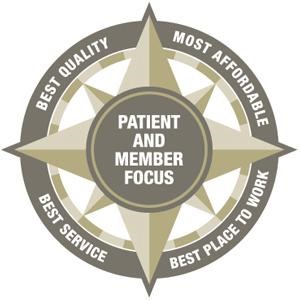
Value Compass

About 35 percent of these projects are focused on reducing waste or improving affordability. And 267 of those projects, produced joint savings of $10 million in 18 months; potential savings are much more. Twenty-eight percent of projects are focused on service enhancement. Here’s a snapshot of improvement projects conducted at each point of the Value Compass:

  • Best quality: A medical imaging team worked across departmental lines to ensure that patients who visited the medical office for a flu shot, and also were due for a mammogram, could get one promptly, many within 20 minutes.
  • Best service: A cross-functional team of service center workers redesigned work processes to handle incoming calls in the wake of the Affordable Care Act. The team cut the number of customer handoffs by 60 percent and reduced mean processing time for members’ issues from 26 days to three days.
  • Most affordable: An inpatient pharmacy team launched a cost-reduction effort that is saving more than $600,000 a year by better managing inventories, alerting physicians to less costly equivalent drugs and reducing drug wastage.
  • Best place to work: As part of our voluntary workforce wellness program, 62 percent of eligible employees – more than 80,000 people – participated in a confidential health assessment to identify potential health risks. 

Getting measurable results

We know our strategy is having an impact on organizational performance and the workplace experience. Our 2014 employee survey showed strong correlations between several measures of employee engagement and job performance.

Departments that scored high on an index of 18 measures of workforce effectiveness (including things like taking pride in the organization, information sharing, understanding of goals and being held accountable for performance) reported significantly better results in service, quality, workplace safety and attendance. For instance:

  • 9 percent higher patient satisfaction scores
  • 18 percent fewer lost work days
  • 41 percent fewer workplace injuries
  • 91 percent fewer bloodstream infections in at-risk patients

In addition, members of high-performing unit-based teams are far more likely to say they have influence in decisions affecting work, are comfortable voicing opinions, and feel co-workers are respected despite differences.

Higher job satisfaction also contributes to significantly lower employee turnover. In California, for instance, our turnover rate for all hospital-based employees ranges from 6 percent to 8 percent, depending on the job type – versus the 2014 industry average of 9.4 percent statewide reported by the California Hospital Association.

Union Coalition members and Kaiser Permanente also collaborate on many issues rarely open to union participation. For instance:

Workforce planning and development: We invest heavily in workforce training and development – and we develop and implement most of that work jointly. For instance, a union-management Jobs of the Future Committee in Southern California is identifying emerging technology, assessing the impact on workers, managers and physicians, and developing training plans and career paths. More such efforts and investments are under way.

Market growth: Bringing together union members and Kaiser Permanente sales and marketing teams, our joint growth campaign helped win, expand, win back or retain 33 accounts covering 125,000 Kaiser Permanente members in 2014.

Meeting organizational challenges

Our partnership is not perfect. It can stretch us to engage and educate our many stakeholders, and find time to solve problems and improve work processes in the course of day-to-day operations.

But in my experience, the biggest challenge is spreading innovation – facilitating the exchange of ideas and the adoption of successful practices from one team, medical center or region to another. We know that new initiatives can take root faster and more consistently if they’re modeled on a proven concept – especially when they are championed by our own work teams. Variation can be a plus when you’re looking for new and better ways to do things; when you’ve found the best way, you need to make it a work standard.

We recognize and spread success by communicating with teams regularly in multiple formats; through peer consultants and sponsors in every facility; a system-wide database that tracks teams’ tests of change and outcomes; and UBT Fairs, where teams share their findings in person.

Keys to success

Our Labor Management Partnership is now in its 18th year, and we are still learning how to take it further. We continue to believe it can be a model for labor relations and health care delivery. Four factors in particular are essential to success:

  • Develop leadership at all levels: Since its founding, our partnership has thrived under three different Kaiser Permanente CEOs and three different Union Coalition executive directors. Change is not sustainable if it depends on one top leader. Frontline and mid-level leadership, on both the management and union side, is key. We train for partnership at all levels, and have found that interest-based problem solving and bargaining are powerful learning development tools for up and coming leaders.
  • Build trust: To work together, partners must trust one another. That trust must be earned, and is established over time. It will be tested, but the building blocks are well known: Do what you say you will do. Honor your commitments. Treat others with respect and deliver results.
  • Measure results and share data: We set goals and track performance for all our teams. We share business and financial data with our partnership unions in bargaining, and share departmental and unit-level results with teams working on performance improvement projects. Teams can’t succeed without good information upon which to set clear expectations.
  • Create a shared framework: Our workforce is diverse in every way – demographic, geographic, professional and technical. We also have different (and sometimes competing) needs, interests and concerns. But we share a desire to make our members’ and patients’ lives better. The Value Compass – with the member and patient in the center – provides a common touch point that we use to set priorities and guide decision making.

Our union and organizational leaders know how to do business in traditional, more adversarial labor relations settings. We’ve done it. We choose to work in partnership – not because it feels better (though it does) or because it’s easier (it’s not). We do it because it gets results – for the organization, the unions and workers, and the members, patients and communities we serve.

It’s time to look beyond labor relations and find new ways to innovate and engage teams. Our leaders took a risk 18 years ago to listen, understand and work together. It proved to be better way to deliver health care and achieve our social mission.

This article was originally published in “Perspectives on Work,” the magazine of the Labor and Employment Relations Association (LERA), Volume 19. Reprinted with permission. For more information, visit LERAweb.org.

Also see a PDF of the original article, with additional information about Kaiser Permanente and the Labor Management Partnership.
Good Partnering Methods Aren’t Just for the Bargaining Table

Deck: 
How the interest-based process keeps potential problems from becoming real problems

Story body part 1: 

A former KP administrator, Michael Belmont now works for Restructuring Associates Inc., the consulting firm that helped during the creation and initial implementation of the Labor Management Partnership and that now helps facilitate national bargaining. He sees interest-based bargaining as a way to solve the problems of the future, before they arise, instead of getting stuck dealing with the baggage of past grievances.

My time at Kaiser Permanente dates back to the late 1980s. I was assistant hospital administrator in Panorama City, dealing with several unions. We were facing so much discord. It was all-encompassing, and it took the focus off improvement issues. The move toward interest-based bargaining and [the] Labor Management Partnership allowed us to put the focus on improving the member experience instead of continually trying to resolve labor problems.

Partnership, especially interest-based bargaining, gives employees and their unions a chance to have an impact on things they might not otherwise. They have a say beyond wages, hours and working conditions. In 2012, there was a bargaining subgroup on growth, focusing both on growing Kaiser Permanente and the unions. In a traditional setting, that doesn’t happen. For employees and their unions, the other side of the interest-based process is responsibility and accountability to take on and help solve the problems of the organization.

When we do trainings on interest-based problem solving, people will say, “This is how I deal with relationships.” If you are going to be a good partner—and have a successful relationship with a partner, kids, friends—you have to have your partner’s interests in mind as well as your own. Making this connection helps people connect the strategy to their work lives.

After 2000 bargaining, the Southern California region was looking for a change in labor relations, away from traditional, toward partnership. We were trying to move labor relations away from being a wall between the unions and management and toward facilitating a productive relationship between unions and management. I saw a gradual transition toward more of a partnering role. I left KP in 2006. I could come back [with Restructuring Associates] as a neutral [party] in 2010 and 2012 because of the [nature of the previous] relationships with union and management officials.

Interest-based bargaining is focused on solving problems up front rather than on grievances. People have to unlearn a lot of habits and build a lot of trust. There was 50 years of baggage [when the partnership started]. A traditional approach leaves lots of scars. Traditional is the comfort zone for most organizations. Traditional approaches are backwards looking: They are about solving problems from the past that pile up and wait for bargaining. Interest-based bargaining is about solving problems and issues that may come up in the future. Using the interest-based approach in bargaining and in day-to-day work is a much more forward-looking way to solve problems—and so much more effective.

Frontline Employees Get Intensive Ebola Preparation

Deck: 
KP, union coalition collaborate on training event

Story body part 1: 

Standing on a stage in front of hundreds of his fellow health care workers at the largest Ebola educational session on the West Coast to date, registered nurse Peter Sidhu demonstrated how to use personal protective gear in the way that keeps both patients and workers safe.

Sidhu inspected his equipment first—two pairs of gloves, a gown, mask and face shield. Then Arjun Srinivasan, MD, the associate director for health care-associated infection prevention programs at the federal Centers for Disease Control and Prevention, gave him detailed, step-by-step instructions in putting them on.  

Resources

The Nov. 7 educational session in Los Angeles was hosted by Kaiser Permanente, the Coalition of Kaiser Permanente Unions and other organizations that are coming together to help frontline caregivers learn about the newest CDC protocols and guidelines for handling Ebola patients. Hundreds attended in person, while thousands more nationwide watched a live telecast of the event.

Affordable Health Care for All

Deck: 
How UBTs are making it happen

Story body part 1: 

Jeff and Sara Simmons describe themselves as a “pretty average, middle-class” family living in a Northern California suburb with their sons. “We live a Lego life with two boys,” laughs Sara, describing her toy-strewn living room.

But eight years ago, Sara was diagnosed with Type 1 diabetes, thrusting her into a routine of checking her insulin, monitoring her diet—and paying steep bills for medication and medical equipment. Recently, 7-year-old Owen also was diagnosed with the disease. And the family has to plan for the possibility that 5-year-old Griffin might be diagnosed with it as well.   

Even though the family has medical insurance with Kaiser Permanente, the new bills related to Owen’s care overwhelmed them. They applied for help from one of KP’s medical assistance programs, which helped tide them over until they could get a handle on their new reality.

In the months since, the Simmonses have made some tough choices—deciding, for example, to sell their home and move to an area with a lower cost of living. But Jeff, a manager in a major corporation, worries about how families with lower incomes and fewer health care benefits than his would have fared under similar circumstances.

“How do they do this?” he wonders. “How are they surviving all of these curveballs?”

Health care is “absolutely not” affordable for most people, he says—then adds, “Everybody should have affordable health care. Period.”

A difficult equation

The passage of the Patient Protection and Affordable Care Act in 2010 was a major step toward ensuring all Americans have access to health care. As provisions of that act take effect in 2014, Kaiser Permanente will have an extraordinary opportunity to further our historic mission of providing affordable, high-quality health care to working families. But with the opportunity comes a difficult financial reality. Because these incoming new members may not have had access to health care in the past, they may be costly to treat—and federal reimbursements may be on the low side. In addition, the federal government has recently cut the rates for Medicare reimbursements, which typically have provided about one-third of KP’s revenue.

So Kaiser Permanente and unit-based teams face the challenge of treating more—and perhaps sicker—patients with fewer resources while maintaining and increasing the quality of care. Now more than ever, allocating our resources wisely is vitally important.

Frugal power

It’s easy to see how departments with multimillion-dollar budgets play a role in keeping KP affordable. For example, National Facility Services kept an eye on potential energy savings when a new data center was built and saved about $450,000 in electricity costs in 2010 and earned a $300,000 incentive from the local utility company. Another example: KP saved $26 million in 2010 alone by buying safer and more environmentally friendly industrial chemicals. And a redesign of the way KP deploys computer workstations saved $12 million as of August 2011.

But unit-based teams have just as big a role to play, even if most don’t control huge budgets. The fact that there are more than 3,500 UBTs across the organization means savings can add up dramatically.

Some teams are saving “light green dollars,” focusing on efforts that indirectly improve the financial picture. That might be boosting service and quality, which helps us get new members and retain the ones we have, or improving patient safety, which reduces a variety of expenses, including costly hospital readmissions.

Others are tackling “dark green dollars,” direct savings that improve the bottom line right away. In fact, efficiency and non-payroll cost reduction is the fastest-growing category of projects for teams, according to an analysis of UBT Tracker data.

Is your team looking for new ways to save light or dark green dollars—or in need of ideas to get started saving? Read Four Ways to Save.

Pages

Subscribe to RSS - Program-wide