Kaiser Permanente and the Alliance of Health Care Unions

Program-wide

Meet Your National Agreement: Change Is Here, Be Prepared

Deck: 
As health care evolves, so do our skills

Story body part 1: 

In the early 2000s, Blockbuster ruled the video rental roost.

Now it’s all but gone.

Blockbuster didn’t adapt to customer needs and technology trends. Netflix did.

Kaiser Permanente and the Coalition of Kaiser Permanente Unions recognize that if you don’t change with the times, you can get left behind.

The National Agreement addresses the importance of preparing for the future in partnership; section 1D of the agreement covers workforce planning and development.

Under the 2015 agreement, two educational trusts — Ben Hudnall Memorial Trust and SEIU UHW-West & Joint Employer Education Fund — received additional funding to provide workers represented by a coalition union with a variety of services, and training and education programs. Joint work on addressing experience barriers, which have sometimes prevented newly trained workers from being hired into KP jobs, is also under way.

The agreement details the structure for coordinating workforce planning and development. A national team aligns, integrates and coordinates workforce development and training efforts in partnership with the regions. Each region has a workforce planning and development committee chaired by labor and management co-leads.

The five key components of this work are:

  • workforce planning and development
  • career development
  • education and training
  • redeployment
  • retention and recruitment

“The goal is to prepare union workers for changes to jobs,” says LeAnda Russell, the coalition’s national coordinator for job innovation. “We support the lifelong learning and career development of our workers.”

It’s paying off. Use of the educational trusts has increased to record levels.

Russell encourages employees to keep learning to build the job skills needed as health care evolves. In other words — don’t hit the rewind button. It’s time to press play.

“Technology is here,” Russell says. “Don’t be afraid.”
 

Navigating the Future

Story body part 1: 

For Carolina Aceves, technology and health care go hand in hand.

Shortly after completing a new online digital fluency course for Kaiser Permanente employees, she saw firsthand how technology can transform a life. Her mother needed a kidney transplant, but neither she nor her siblings were a match. In October 2017, however, in a series of matches orchestrated through a national computer system, she donated a kidney as part of a chain of donations that resulted in her mother receiving a kidney.

In December, she returned to work at the California Service Center in San Diego, where she is an account administrative representative, fielding calls from KP members and answering their questions. She also chairs a young leader council for OPEIU Local 30 — and is leveraging that role to mobilize all represented members of her unit-based team, urging colleagues of all ages to take the digital fluency course.

“Health care is changing,” Aceves says. “Be current. Do your homework. Advance your career.”

At ease with technology

Digital fluency is one of four critical skills that will be essential in the health care of the future. The new online program, which helps participants understand the role of technology in health care, is free to workers represented by a union in the Coalition of Kaiser Permanente Unions through the Ben Hudnall Memorial Trust, the SEIU UHW-West & Joint Employer Education Fund, and National Workforce Planning and Development.

The national workforce office also is developing programs for the other three critical skills — consumer focus, collaboration and process improvement — as part of a larger strategy to encourage employees to upgrade their skills, advance their careers and meet the changing demands of health care.

“Whether you work in a medical center, clinic or office, we encourage employees to take the digital fluency program,” says Monica Morris, the director of National Workforce Planning
and Development.

Digital fluency skills are good for workers, KP members and the organization, says Jessica Butz, the coalition’s national coordinator for Workforce Planning and Development. While some may fear technology will eliminate jobs, the push at KP is to use it not to replace workers but to enhance the care and service they deliver.

“Learning these critical skills will prepare our workers for jobs in the future and give them the tools to shape and improve care for our members and patients,” Butz says.

TOOLS

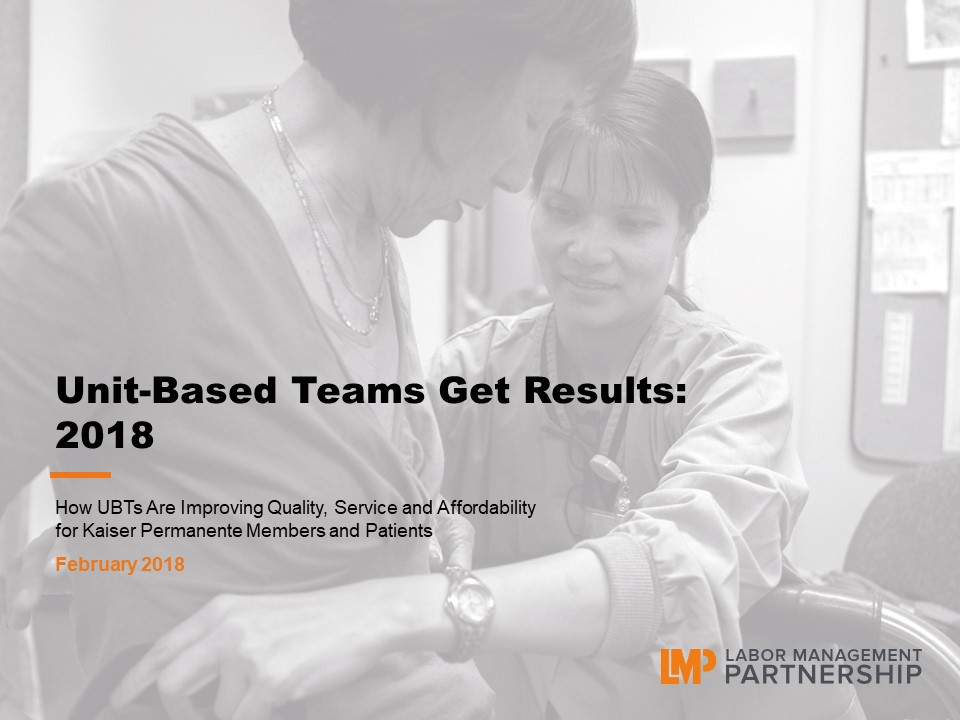
Unit-Based Teams Are Getting Results: 2018

Format:
PowerPoint

Size:
10 pages, 8.5" x 11"

Intended audience:
Unit-based team members, co-leads, sponsors and consultants; union and KP leaders

Best used: 
Share in presentations or team meetings to see successful practices from UBTs across Kaiser Permanente.

Related tools:

How Managers Can Support Career Development

Deck: 
5 tips to strengthen your team—and the organization

Story body part 1: 

One of a manager’s most important roles may not appear on the job description—but goes hand in hand with getting results.

“Managers have a key role in helping employees build successful careers,” says Maria Aldana, a career counselor with the SEIU UHW-West & Joint Employer Education Fund, one of two education trusts supported by the Labor Management Partnership between Kaiser Permanente and the Coalition of Kaiser Permanente Unions. “A great leader creates other leaders.”

Fortunately, Kaiser Permanente managers have many ways to support their employees’ development and ensure their department’s success. Here are five.

1. Have career conversations with employees. Talks can be brief and happen anytime and anywhere during the work day, not just during annual performance evaluations. Get tips at Kaiser Permanente’s leadership and management portal (sign-in required) and at Skillsoft @ KP (sign-in required), an on-demand, mobile-ready catalog of learning resources.

“We need to keep and grow our people so they are ready for the changes in health care,” says Beth Levin, a career counselor and outreach coordinator with the Ben Hudnall Memorial Trust, which serves all members of the Coalition of Kaiser Permanente Unions outside of SEIU UHW.

2. Know what resources are available. My HR and KP Learn have resources available for all KP employees, and the LMP website offers tips, tools and practices for individual and team development. Employees can learn about the four critical skills, explore career paths and access tuition reimbursement at kpcareerplanning.org.

The two education trusts offer courses at every level of development, many at no cost to employees, as well as career counseling, tuition assistance programs and more.

3. Work with career counselors. Education trust career counselors can tailor training, provide one-on-one career planning and coaching, and help with skill assessments.

For example, an indexing clerk manager in Colorado told Aldana how his employees needed more computer skills to keep doing their jobs effectively. She met with employees, discussed changes in their field, informed them of available resources and developed a plan that included onsite training.

4. Schedule time for employees to take classes. “Labor and management can come up with a schedule that works and we can offer the training,” Aldana says. “We usually can find vendors that come on site.”

5. Look for development opportunities for employees. Managers can suggest that an employee lead a huddle, serve on a committee, or become an active unit-based team participant or health and safety champion to “gain experience, build skills and network,” Levin says.

Building such engagement can get employees excited about change and encourage them to build their skills.

“When one person is successful, it inspires and motivates other people,” says Levin.

TOOLS

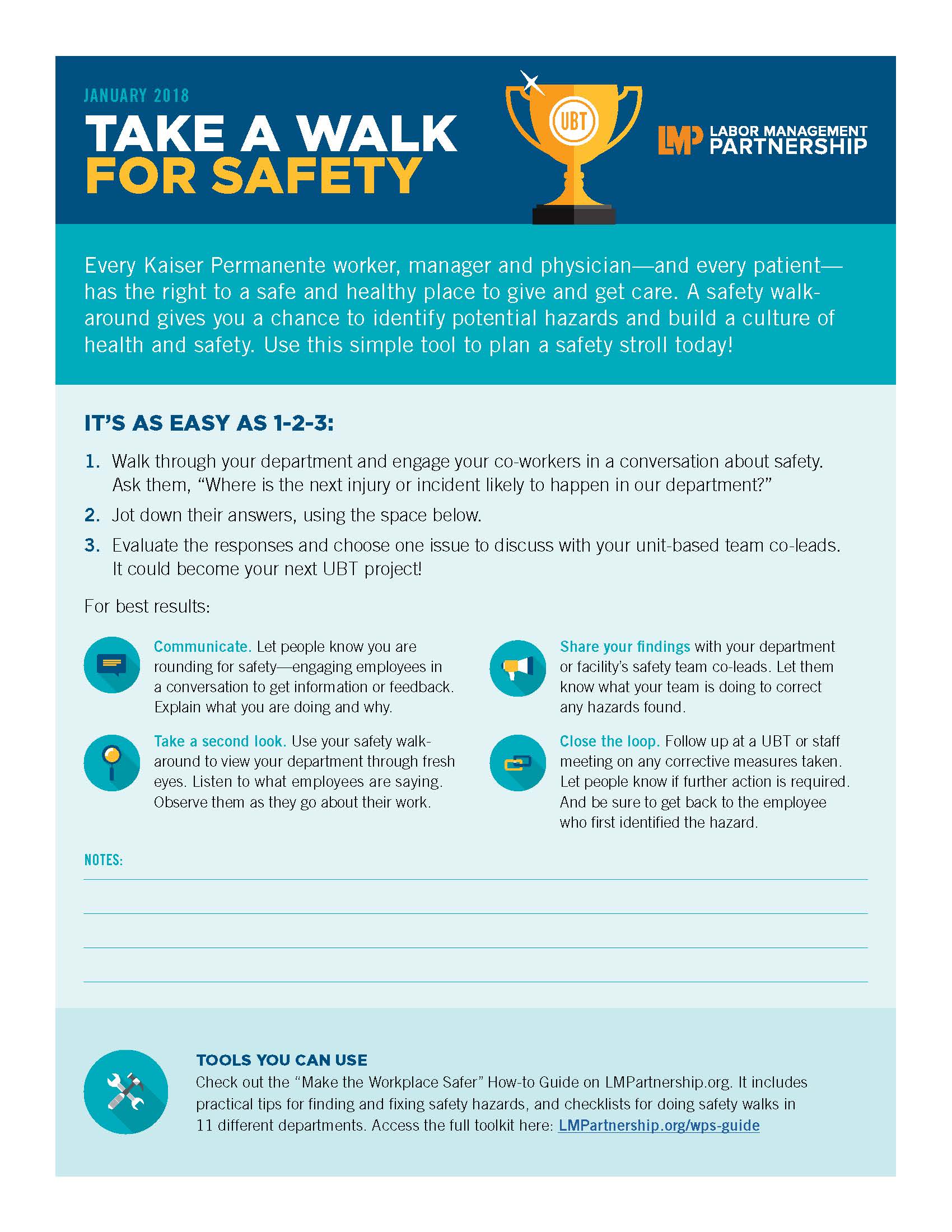
Health and Safety Champions—January 2018 Focus

Format:
PDF

Size:
One page, 8.5" x 11"

Intended audience:
UBT health and safety champions

Best used:
Follow these steps to lead a safety walk-around in your department.

Related tools:

Six Ways to Keep Your Skills Sharp

Deck: 
Kaiser Permanente, union members prepare for the workforce of the future

Story body part 1: 

Looking to stay current in the fast-changing world of health care? You’re not alone.

Kaiser Permanente leaders, labor representatives and industry experts offered insights at November’s Workforce of the Future Conference in Berkeley, California.

“We’ve made a lot of progress over the last few years,” said Monica Morris, director of National Workforce Planning and Development, who welcomed the audience of 200 labor and management representatives tasked with advancing the Labor Management Partnership’s Workforce of the Future initiative. “Now it’s time to do even more.”

Here are six strategies you can follow to prepare for the workforce of the future.

Learn new ways to work. During the Industrial Revolution, cobblers and weavers had to adapt or get left behind. This process continues today—only now, it’s happening faster, said keynote speaker Art Bilger, founder and CEO of WorkingNation, a nonprofit group seeking solutions for economic change.

“The solutions are local,” he said. “Communication of these issues and solutions is critical.”

Become lifelong learners. Skills used to last a lifetime and career paths were clear. Now there’s a new development every 18 months. Get on the cutting edge and imagine the opportunities technology provides.

“Be deeply curious. We’re all newbies,” said keynote speaker John Seely Brown, an author, scholar and former director of the Xerox Palo Alto Research Center, who gives high marks to the innovative learning approach of the new Kaiser Permanente School of Medicine.

Keep developing your career. Age is not a barrier to lifelong learning, said keynote speaker Sandi Vito, executive director of 1199SEIU Training and Employment Funds, which partners with Montefiore Health System in New York.

“People tend to think that employees in their 50s can’t aspire to career advancement,” Vito said. “It just requires different approaches. Adults learn more by doing.”

Indeed, the average age of participants in the two LMP-supported educational trusts (Ben Hudnall Memorial Trust and SEIU UHW-West & Joint Employer Education Fund) is 44.

Use available resources. Kaiser Permanente employees have many resources to advance their careers, including targeted training programs for workers represented by the Coalition of KP Unions.

To start, learn four critical skills that will be essential to the future of health care. A digital fluency program launched in October, to be followed by programs in consumer focus, collaboration and process improvement.

“We don’t know what the jobs of the future will be,” said conference facilitator Tony Borba, Northern California regional director for The Permanente Medical Group. “We need to use our resources so we are ready for changes in the workforce.”

Tap the power of partnership. As Kaiser Permanente and the Coalition of KP Unions have successfully partnered, Montefiore and 1199SEIU have developed collaborative training programs, such as community health worker apprenticeships that benefit employees, the organization and the community, said keynote speaker Lynn Richmond, Montefiore’s chief strategy officer.

Get involved. The conference produced actionable ideas such as developing a communications strategy to show the value of continuous learning and generate more on-the-job training. Other ideas included apprenticeships and reverse mentoring.

“How do we leverage the power of preceptors, mentors and the educational trusts?” said conference speaker Jessica Butz, the union coalition’s national program coordinator for Workforce Planning and Development. “This is your chance to help shape what we do at Kaiser Permanente.”


Let’s Get Digital

Deck: 
New digital fluency program sharpens skills for work, home and family life

Story body part 1: 

Kaiser Permanente medical assistant Abelene Cerezo-Kirtley used to fear computers, but not anymore.

Inspired by her 84-year-old father, she took a pilot digital fluency course that made her more comfortable with technology, empowering her to provide better care for her patients—and her family.

As her father’s health advocate, she used her training to create a spreadsheet to track his insulin injections, consolidated his medical records on an iPad, and presented it to his physician.

“He asked me, ‘Are you a doctor?’” Cerezo-Kirtley says. “I said, ‘No, I’m a medical assistant.’ It made me feel 10 feet tall, and I’m only 4-foot-10.”

The new online program is free to all members of the Coalition of Kaiser Permanente Unions through the Ben Hudnall Memorial Trust, the SEIU UHW-West & Joint Employer Education Fund, and National Workforce Planning and Development. Visit kpcareerplanning.org, the Ben Hudnall Memorial Trust or the SEIU UHW-West & Joint Employer Education Fund websites to sign up.

A workforce development strategy

The digital fluency program, which takes four to six hours to complete, helps employees understand the role of technology in health care and know where to find additional learning resources. It’s part of a larger workforce strategy to encourage employees to upgrade their skills, advance their careers and meet future health care challenges.

“Digital fluency is one of four critical skills we’ve identified that Kaiser Permanente employees need to meet the changing demands of health care,” says Monica Morris, National Workforce Planning and Development director. “Whether you work in a medical center, clinic or office, we encourage employees to take the digital fluency program.”

Gaining skills builds confidence

Cerezo-Kirtley, now studying American Sign Language to better serve patients who are deaf or hard of hearing, has constantly upgraded her skills during her 19 years as a medical assistant at Kaiser Permanente’s Sacramento Medical Center. Her father, a retired airline mechanic who earned a master’s degree, modeled lifelong learning, and KP has enabled it through negotiated benefits such as tuition reimbursement. Cerezo-Kirtley, a member of SEIU-UHW, jumped at the chance to improve her digital fluency.

“The digital fluency program gave me the confidence to keep wanting to learn more,” says Cerezo-Kirtley. “It helped me care better for my family and my patients.”

Her manager, Jennifer Henson, RN, agrees. “It’s important to support our staff to advance themselves, which in turn promotes better health within the company,” says Henson, who has used tuition reimbursement herself to earn her nursing degree and is now working toward a master’s degree.

Past, Present and Future

Story body part 1: 

As we celebrate the 20th anniversary of the Labor Management Partnership, Hank would like to call out the tens of thousands of individuals who have made partnership a success: the frontline workers, managers and physicians who have believed in our ideals and taken the time to build the positive working relationships that are the backbone of this groundbreaking endeavor.

Visit Humans of Partnership to read their stories—and look through their eyes into our past, our present and our future. 


The Road Taken

Deck: 
20 years of national program results

Story body part 1: 

Workforce Planning and Development

Key accomplishments

  • Program enrollments in Kaiser Permanente’s two education trusts grew from about 3,000 in 2007 to nearly 62,000 in 2016. 
  • Tuition reimbursement course applications nearly tripled, from less than 20,000 in 2008 to more than 57,000 in 2016, largely benefiting members of unions in the Coalition of Kaiser Permanente Unions.
  • Critical skills training launched in June 2017 with a Digital Fluency pilot program for more than 2,000 employees.

Going forward

  • A top priority will be addressing the impact of economic, social and technological changes on care delivery and future KP staffing models. (Learn more at kpworkforce.org.)

Workplace Safety

Key accomplishments

  • Since program inception in 2001, KP’s injury rate has been reduced by 69 percent.
  • Injuries associated with patient handling and/or mobilization have decreased by 32 percent since 2011.
  • The program-wide workplace safety strategy was strengthened in 2016, based on the National Safety Council’s model.

Going forward

  • The strengthened safety strategy will be implemented, with the goal of closing the gap between KP’s injury rate and the Bureau of Labor Statistics adjusted injury rate for health care.

Total Health

Key accomplishments

  • More than 76,000 employees have taken the Total Health Assessment (THA) since 2014.
  • Ninety percent of eligible employees completed their recommended health screenings in 2014 and 2015, earning a $40 million payout under the Total Health Incentive Plan.
  • More than 3,000 UBT health and safety champions helped teams across the organization conduct 1,756 wellness projects in 2016—a 45 percent increase from 2015.

Going forward

  • New awareness campaigns, including one focusing on prediabetes education, will inform and empower employees to take charge of their own health and wellness.

Joint Marketing and Growth

Key accomplishments

  • Helped secure more than $108 million in revenue for Kaiser Permanente in 2016.
  • Supported the 20-year growth in the number of employees represented by a union in the Coalition of Kaiser Permanente Unions, from 57,000 to 116,000, and in Kaiser Foundation Health Plan membership, from 7.4 million members to 11.8 million. 
  • Since 2012, mobilized 51 union ambassadors who attended more than 300 community events and engaged more than 70,000 KP members and potential members—many of them unionized—increasing community knowledge and understanding of KP.

Going forward

  • Through the expansion of health plan membership, support job security and the continued growth of the coalition.

Attendance 

Key accomplishments

  • Enhanced time-off benefits to provide incentives for appropriate use of sick leave.
  • Developed the Time-Off Request Tracking System to provide greater flexibility and responsiveness in managing planned time off.
  • Achieved 21 percent fewer lost workdays in high-performing UBTs. 

Going forward 

  • Attendance data, systems and results will continue to be assessed and improved.


Pages

Subscribe to RSS - Program-wide