TOOLS
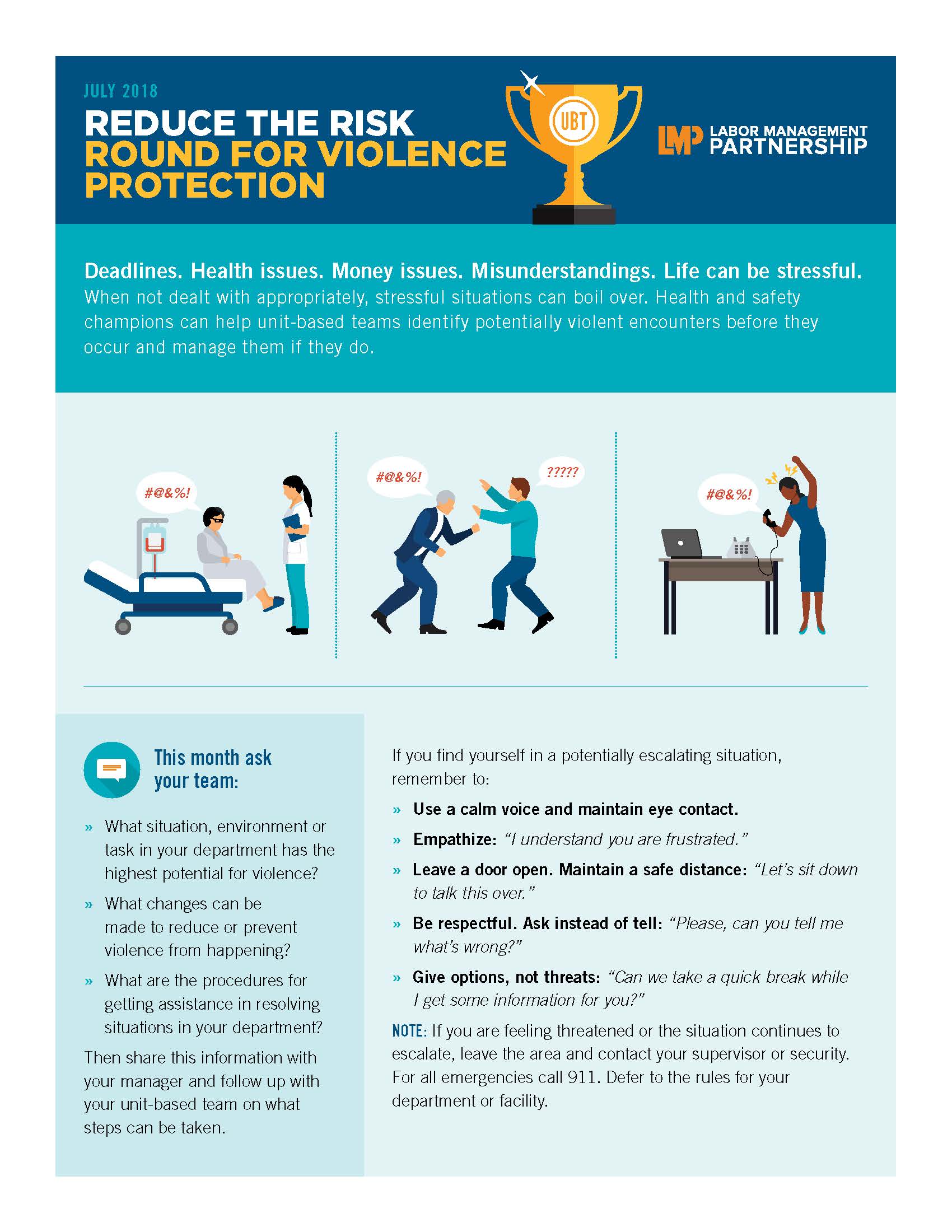
Health and Safety Champions—July 2018 Focus
Format:
PDF
Size:
One page, 8.5" x 11"
Intended audience:
UBT health and safety champions
Best used:
Use this tool to round for workplace violence prevention.
Format:
PDF
Size:
One page, 8.5" x 11"
Intended audience:
UBT health and safety champions
Best used:
Use this tool to round for workplace violence prevention.

The LMP website can help you save time and do your work better. And now you've got it in your pocket!
Get tips and tools to navigate LMPartnership.org like a pro while at your desk or on the go.
You can also visit the Q2/Q3-2018 Hank web page in the Library section to read the issue online or download a PDF of it.
Minimum order: 25
Do you or your teammates want to shrink wait times? Save money on supplies? Reduce time wasters or roadblocks? Once you’ve identified a problem to solve, you may wonder where to start. No need to invent an improvement project from scratch. Visit the Team-Tested Practices section and see what’s worked for others. We’ve got short summaries of successes from every region and every type of work environment to give your team a kickstart.
1. What’s here?
When you visit LMPartnership.org/team-tested-practices, you’ll find the first several “tiles” of the dozens you can choose from as you scroll through this section. Each tile will have a photo and short preview about a specific, measurable improvement a team has made.
2. Sharpen your search
Want to narrow down what you see? Use the filters on the left side of the page. There are several to try, including:
Selecting more than one filter at a time works, too. And remember that you can get great ideas from departments very different from yours and regions other than your own. You’ll notice these filters throughout the website to help you focus your searches.
3. Intrigued?
See something your team might want to try? Click on the tile to get a more complete description of the challenge the team was facing — and the main tests of change that helped the team achieve its goal. And the measurable result: “Saved $40,000,” “decreased wait times by 11 minutes,” “69 percent drop in costs.”
4. No dead ends!
So, maybe the practice you clicked on isn’t right for your team. Before you move on, check out the related tools and stories in the colorful columns farther down this page. Throughout the site, the color orange means, “Here are tools to get your team started on work like this.” Blue is, “Get inspired by stories and videos about teams working on similar efforts!” And, “Just for fun” — green will take you to puzzles, games and other light-hearted resources to kick off your improvement campaign on an upbeat note.
What’s your favorite thing to do online? Watch cat videos? Scroll through Facebook? Maybe some occasional retail therapy?
Going online can also help make your work life better and save you time. It can help your unit-based team solve problems so you can deliver the best care and service to our members and make Kaiser Permanente a great place to work. All that, after all, is what the Labor Management Partnership is all about.
This issue of Hank magazine is a whirlwind tour of the Labor Management Partnership website, a one-stop shop for everything you need to turbocharge your team’s performance. Tip sheets, videos and inspiration are always just a few clicks away. If you can’t find what you want easily, just use our vastly improved search function. As one of our biggest fans put it, “Boom — there it is!”
On LMPartnership.org, you will:
If you don’t sit at a computer as part of your day-to-day work, it’s easy to access LMPartnership.org on the go. Follow these instructions so we’re always at your fingertips on your smartphone. You’ll find yourself in a UBT meeting and calling up just the tool you need to help a team through a sticky situation.
You can even share resources from your phone with others who may not be as smartphone savvy. Pretty much every page has buttons that make it easy to email it to a colleague or share it on Facebook or Twitter.
Here’s another handy tip: even if you don’t visit LMPartnership.org (though I hope you do), reading this issue of Hank will help you learn how and why we do the vital work we do. So read on, log on and enjoy.
Let's be real: If everything is important, nothing is important. The prize for us is providing high-quality care and service at an affordable price to our members, patients and communities we serve — and the Focus Areas section of LMPartnership.org is a tool for helping unit-based teams prioritize their work and stay grounded.
What will you find here? Let’s start with the Value Compass. The Focus Areas section has pages that go in depth on each of the four points — Quality, Service, Affordability and Best Place to Work. You also can learn more about topics that are part of the National Agreement, including Total Health and Workplace Safety, Workforce Planning and Development (Workforce of the Future), and Union and KP Growth.
And then two pages are specifically for improving your team’s culture — which will in turn improve performance (we have the stats to prove it). The Join the Team, Be the Change page has tips and tools for improving team communication and engagement, while the Free to Speak page will help you build a Speak Up culture on your team.
How do you get your unit-based team to be excited about the work? Why would staff members want to be involved? How do you get those quiet people — who you just know have great ideas — to speak up?
Ideas to answer these questions and many more are found on the Join the Team, Be the Change page of the website. You’ll find tips and tools for improving team communication, the first step in getting employees interested and involved.
But it doesn’t stop there. As communication improves, it’s easier for the team to pull together and solve problems — which in turn raises morale and can foster a sense of joy at work. Teams with good communication have more fun, report higher engagement, have better People Pulse scores and are rated higher on the Path to Performance.
And when employees are happy and satisfied with their jobs, our members and patients feel the difference in the care we give. Have fun with your team and make things happen!
Format:
PDF
Size:
8.5" x 11"
Intended audience:
Farmers market champions
Best used:
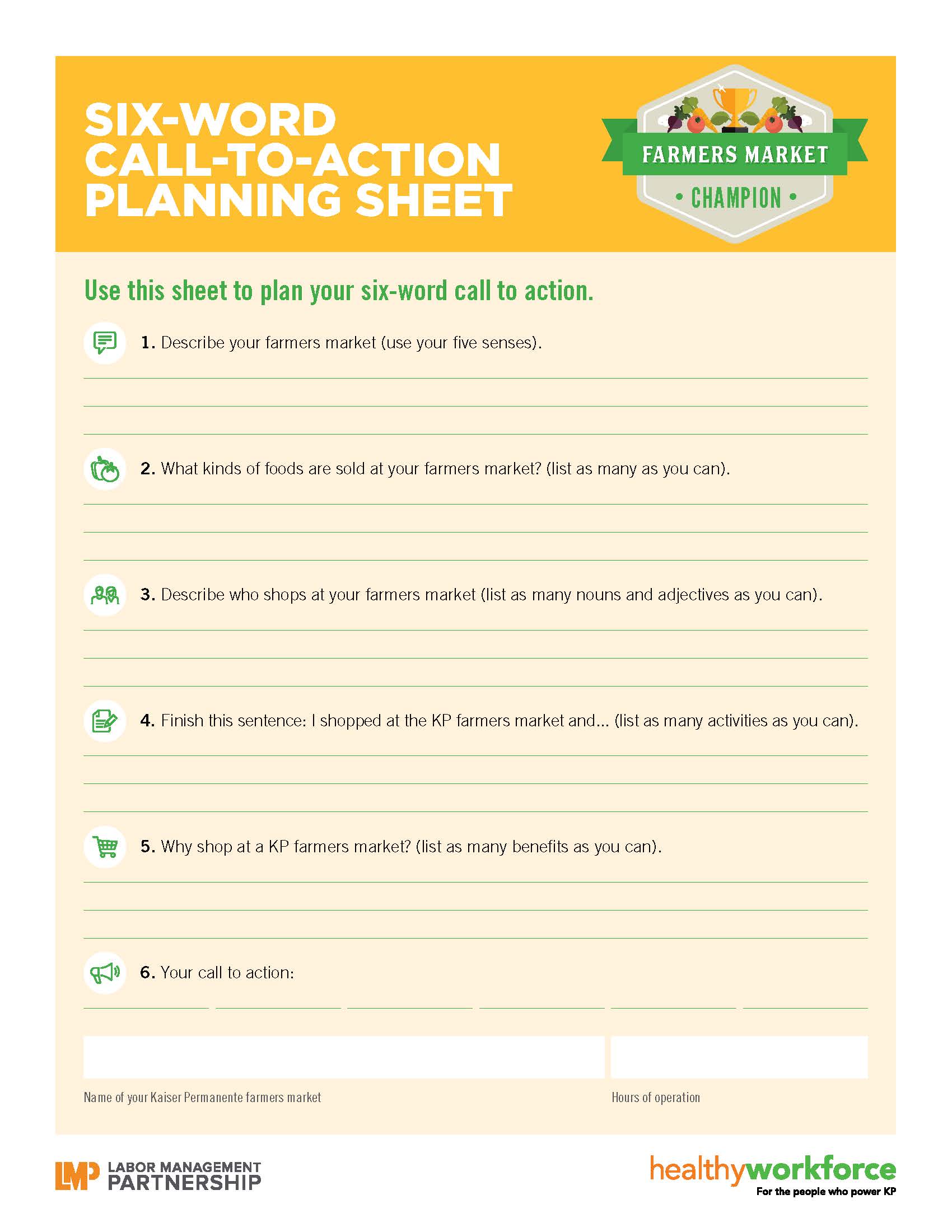
Use this planning sheet to create a compelling six-word call to action for your farmers market.
Related Material:
Call-to-Action Poster
If your union is party to the 2015 Coalition National Agreement, you may be eligible to convert your unused banked sick leave to a Health Reimbursement Account (HRA) when you retire from Kaiser Permanente. You can use the Sick Leave HRA to help pay for eligible out-of-pocket medical, dental, vision and hearing care expenses on a tax-free basis.
The Sick Leave HRA gives you a strong incentive to bank your unused sick time and helps ensure that you will have sick time when you need it. This benefit is separate from and in addition to the Retiree Medical HRA established as part of the retiree medical benefits package in the 2015 Coalition National Agreement.
See the Retirement Programs section of your Summary Plan Description on MyHR for details:
If that benefit is not included in your Summary Plan Description, you are not covered by the benefit.
How would you want your mother or grandmother to be treated if she came in for an outpatient appointment at Kaiser Permanente? That’s how we want to treat all of KP’s members. Thousands of unit-based teams are working to make sure every KP member receives top-notch service, from the first phone call to the visit with the care provider to the member’s departure from the facility. Providing great service will make our members’ lives better.
Health care workers’ first obligation is “do no harm”— to see that the members and patients in our care suffer no injury or further illness. Unit-based teams across Kaiser Permanente launch hundreds of projects every year to improve patient safety. These tips can your guide your team in a patient safety improvement project and help ensure that KP is the safest place to get and to give care.