Kaiser Permanente and the Alliance of Health Care Unions

LMP Processes

Ebola Education and Safety Agreement

This 2014 agreement lays out measures to train and protect caregivers treating Ebola patients.

Agreement Between the Coalition of Kaiser Permanente Unions and Kaiser Permanente

December 15, 2015

1. As both Kaiser Permanente and the Coalition of Kaiser Permanente Unions agree, the threat and fear around caring for a patient with Ebola is a fact that must be addressed. The parties believe that by remaining calm and educating our employees/members, we can work together to ensure that the employees are prepared through knowledge and trai ning to care for an Ebola patient. The Employer and the Union are committed to work together to effectively implement CDC guidelines related to Ebola. In the event the guidelines change, the parties will meet, review and bargain the effect of said changes. In addition, the parties will develop joint communications for all employees and when Kaiser Permanente's national guideline is more protect ive than the CDC and Cal OSHA guidelines, Kaiser Permanente's national guidelines shall prevail. In no event will Kaiser Permanente's national guidelines be a lower standard than the CDC. In California, the receiving hospitals will meet Cal/OSHA regulations and guidelines, including Interim Guidance on Ebola Virus in Inpatient Hospital Settings and the Aerosol Transmissible Diseases Standard. In addition, facilities must follow applicable OSHA or local public health requirements.

2. In reference to number 1 above, the Employer will ensure sufficient levels of all required PPE in the ambulatory setting, Emergency Department and Inpatient settings. All trained employees have the opportunity to regularly practice these skills with drills, simulat ions or other relevant activities.

3. All staff with the potential to interact with, care for, or do terminal cleaning/waste handling for suspected Ebola patients, or those with a positive diagnosis, shall receive paid time for the purpose of

a)      education on Ebola to include but not limited to:

i)        pathophysiology
ii)       signs and symptoms
iii)      care and treatment of the patient
iv)      proper donning and doffing of PPE
v)       simulation of actual care e.g. IV starts while donned, etc.
vi)      proper disposal of body fluids and waste
vii)     terminal cleaning of isolation rooms in the ambulatory, Emergency Department and Inpatient settings
viii)    the appropriate duration of time in room or in PPE, per KP guidelines and CDC, Cal OSHA, and OSHA standards
ix)      proper protocols for intake areas

b)       such training shall be paid training time by the Em ployer with backfill for those in training

4. The CDC recommends that there are Ebola teams to care for patients. Ebola teams will be selected in alignment with National HR policy 043

a)      volunteers first; in the event there are insufficient volunteers, then
b)      team member selection shall be identified by the parties at the local level

5. In the event an employee is excluded from work or receives care as a result of occupational exposure to Ebola, the employee will receive Paid Administrative Time Off, and all medical costs will be covered through Employee Health and Workers' Compensation in accordance with HR Policy 042 Exposure to Ebola. In addition, if psychological support is needed , all employee costs shall be covered under Workers ' Compensation and/or the employee's health plan benefits in effect at the time of the injury.  Paid Administrative Leave shall be considered time worked for purposes of benefits accrual.

6. In each region, joint communication plans will be put into place or continue, as appropriate.

7. In the event there is a dispute over the above, a designated CKPU Member Union Representative and the local Ebola KP site manager will convene a meeting within 24 hours to resolve the dispute within one meeting. 

Download a PDF of the agreement with signatures. 
1997 Labor Management Partnership Agreement

Story body part 1: 

This landmark agreement between Kaiser Permanente and the Coalition of Kaiser Permanente Unions established the Labor Management Partnership and laid out the core principles, structures and commitments that guide it.

October 1997

Purpose

Health care services and the institutions that provide them are undergoing rapid change. Advances in health care and the explosive growth of for-profit health care businesses present challenges as well as opportunities for Kaiser Permanente, the unions, and the members they represent. Kaiser Permanente and the undersigned labor organizations believe that now is the time to enter into a new way of doing business. Now is the time to unite around our common purposes and work together to most effectively deliver high quality health care and prevail in our new, highly competitive environment.

As social benefit membership organizations, founded on the principle of making life better for those we serve, it is our common goal to make Kaiser Permanente the pre-eminent deliverer of health care in the United States. It is further our goal to demonstrate by any measure that labor-management collaboration produces superior health care outcomes, market leading competitive performance, and a superior workplace for Kaiser Permanente employees.

In this spirit and with this intent, Kaiser Permanente and the undersigned labor organizations agree to establish a Partnership in pursuit of our common goals to:

  • Improve quality health care for Kaiser Permanente members and the communities we serve;
  • Assist Kaiser Permanente in achieving and maintaining market leading competitive performance;
  • Make Kaiser Permanente a better place to work;
  • Expand Kaiser Permanente's membership in current and new markets, including designation as a provider of choice for all labor organizations in the areas we serve;
  • Provide Kaiser Permanente employees with the maximum possible employment and income security within Kaiser Permanente and/or the health care field;
  • Involve employees and their unions in decisions.

back to top

Standing Agreements

Enduring guidelines for our work

The Labor Management Partnership is governed by a series of agreements between Kaiser Permanente and its Partnership unions. The 1997 Partnership Agreement established its founding goals and principles; it is the foundational document for the partnership between KP and the Coalition of Kaiser Permanente Unions. The 2018 Alliance Labor Management Partnership Agreement establishes the guidelines for the partnership between KP and the Alliance of Health Care Unions. 


Good Partnering Methods Aren’t Just for the Bargaining Table

Deck: 
How the interest-based process keeps potential problems from becoming real problems

Story body part 1: 

A former KP administrator, Michael Belmont now works for Restructuring Associates Inc., the consulting firm that helped during the creation and initial implementation of the Labor Management Partnership and that now helps facilitate national bargaining. He sees interest-based bargaining as a way to solve the problems of the future, before they arise, instead of getting stuck dealing with the baggage of past grievances.

My time at Kaiser Permanente dates back to the late 1980s. I was assistant hospital administrator in Panorama City, dealing with several unions. We were facing so much discord. It was all-encompassing, and it took the focus off improvement issues. The move toward interest-based bargaining and [the] Labor Management Partnership allowed us to put the focus on improving the member experience instead of continually trying to resolve labor problems.

Partnership, especially interest-based bargaining, gives employees and their unions a chance to have an impact on things they might not otherwise. They have a say beyond wages, hours and working conditions. In 2012, there was a bargaining subgroup on growth, focusing both on growing Kaiser Permanente and the unions. In a traditional setting, that doesn’t happen. For employees and their unions, the other side of the interest-based process is responsibility and accountability to take on and help solve the problems of the organization.

When we do trainings on interest-based problem solving, people will say, “This is how I deal with relationships.” If you are going to be a good partner—and have a successful relationship with a partner, kids, friends—you have to have your partner’s interests in mind as well as your own. Making this connection helps people connect the strategy to their work lives.

After 2000 bargaining, the Southern California region was looking for a change in labor relations, away from traditional, toward partnership. We were trying to move labor relations away from being a wall between the unions and management and toward facilitating a productive relationship between unions and management. I saw a gradual transition toward more of a partnering role. I left KP in 2006. I could come back [with Restructuring Associates] as a neutral [party] in 2010 and 2012 because of the [nature of the previous] relationships with union and management officials.

Interest-based bargaining is focused on solving problems up front rather than on grievances. People have to unlearn a lot of habits and build a lot of trust. There was 50 years of baggage [when the partnership started]. A traditional approach leaves lots of scars. Traditional is the comfort zone for most organizations. Traditional approaches are backwards looking: They are about solving problems from the past that pile up and wait for bargaining. Interest-based bargaining is about solving problems and issues that may come up in the future. Using the interest-based approach in bargaining and in day-to-day work is a much more forward-looking way to solve problems—and so much more effective.

TOOLS

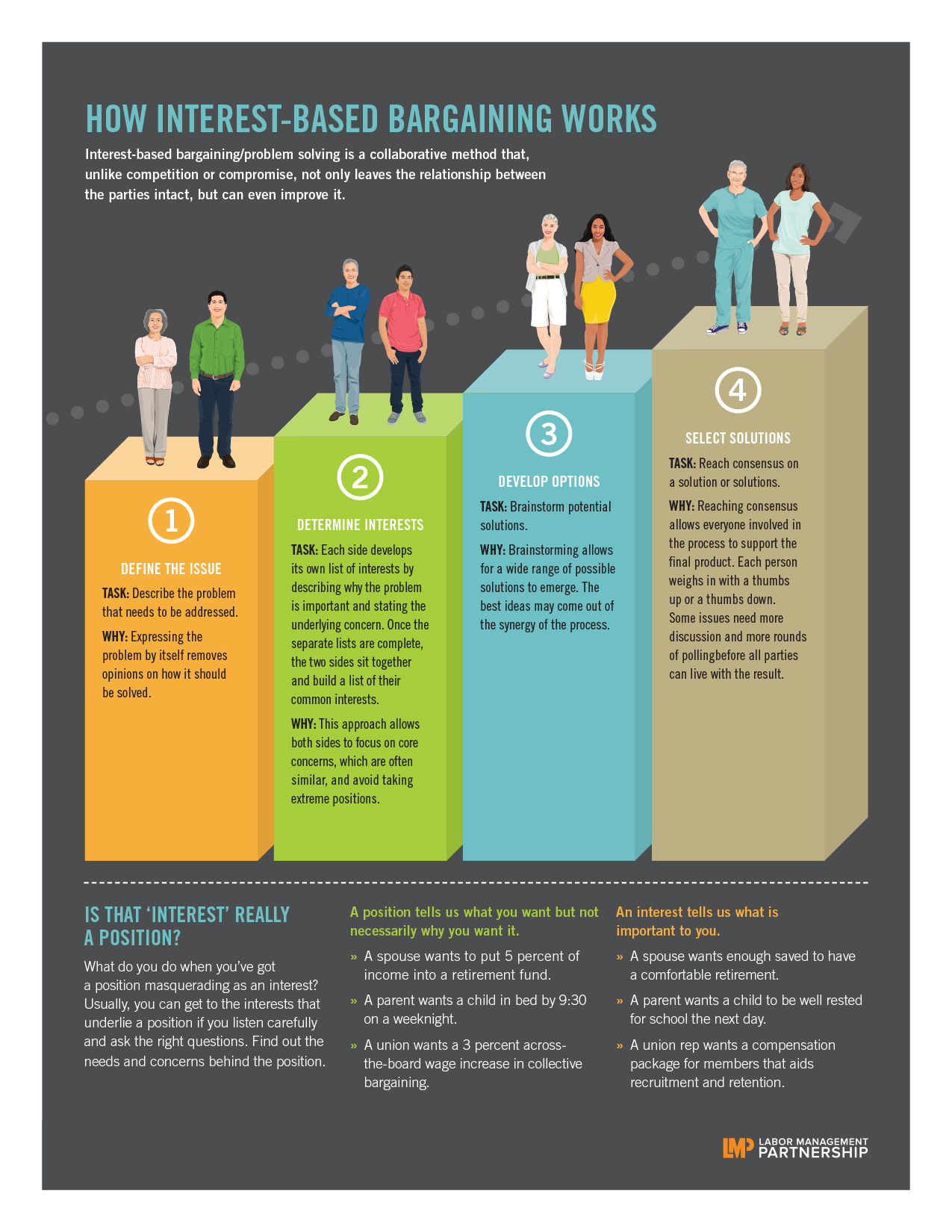
Poster: How Interest-Based Bargaining Works

Format:
PDF (color and black and white)

Size:
8.5” x 11”

Intended audience:
Frontline employees, managers and physicians

Best used:
Help your team learn to effectively solve problems using the four steps of interest-based problem solving. 

Related tools:

TOOLS

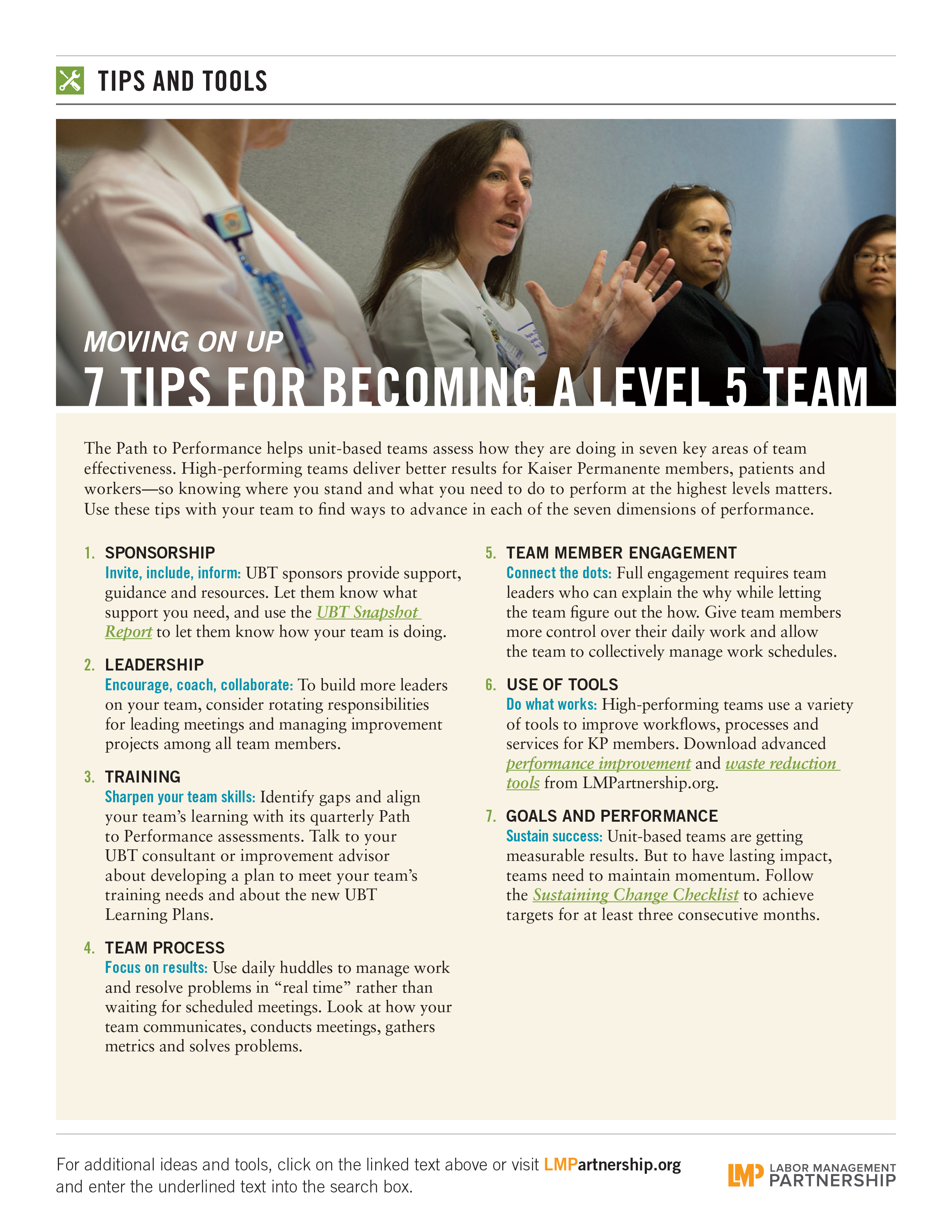
Moving on Up: 7 Tips for Becoming a Level 5 Team

Format:
PDF

Size:
8.5" x 11"

Intended audience:
Unit-based team members, co-leads, sponsors and consultants

Best used:
This tipsheet suggests ways teams can reach Level 4 or Level 5 in each dimension of the Path to Performance. Post on bulletin boards and discuss in team meetings; use these tips to engage your team in specific actions.

Related tools:

Summits Supercharge Performance Improvement Efforts

Deck: 
In addition to the training they provide, the events build energy and communicate priorities

Story body part 1: 

Want to supercharge efforts to improve performance and help reach Kaiser Permanente’s strategic goals? Then bring unit-based team leaders together for a summit.

UBT consultants at several facilities in Southern California have organized summits that focused on Performance Sharing Program (PSP) goals, performance improvement strategies and affordability projects. All say they are seeing results in the forms of more robust UBT projects, clearer SMART goals, and stronger alignment between top medical center leadership and the work of UBTs.

After seeing teams improve service scores, reduce workplace injuries and save more than $160,000 in just four months in the San Diego service area, Sue Smith, a senior UBT consultant, concludes, “The overall experience was wonderful. Many teams had an exciting opportunity to network with other teams and learn new skills in a fun way.”

This spring, San Diego Medical Center hosted a UBT affordability summit, which brought together co-leads for a half-day to build the skills to tackle a new PSP goal for 2014 in the region: to increase the percentage of UBTs that successfully complete a project with hard dollar savings or improved revenue capture. (The projects are reviewed by finance departments to ensure they could lead to cost savings.)

Seated around large tables, UBT co-leads played a spirited game of “KP-opoly,” which offered a crash course in the organization’s finances. They heard from a UBT whose work resulted in cost savings. And they had time to work on driver diagrams and process maps for their own team’s affordability projects.

Co-leads gain PI skills

The year before, San Diego leaders—inspired by an event at the Riverside Medical Center—had held a more general, daylong UBT summit. That event brought UBT co-leads together for intensive training on performance improvement tools and created a space for them to refine their existing projects. Deadlines were set for finalizing driver diagrams and process maps, beginning tests of change and formulating sustainability plans.

The effort culminated in a UBT fair that showcased the projects that had begun as mere inklings at the summit: The ultrasound UBT demonstrated how it had gone injury-free for six months (it had been having at least one injury per month); the diagnostic imaging department boosted patient satisfaction scores from 87 percent in May 2013 to 93 percent in December.  

Leaders at the Woodland Hills Medical Center followed the same playbook, hosting an LMP summit in April that launched an array of of affordability projects to be showcased at a UBT fair scheduled for mid-July.

Mobilizing on PSP

At Fontana and Ontario medical centers, UBT staff used the summit model to mobilize the workforce around all of the region’s PSP goals. Top leaders from both management and the unions kicked off the day, then gave subject matter experts each 10 minutes to discuss the goal (whether it be service, workplace safety, attendance, etc.) and challenge co-leads to take on a performance improvement project to tackle it. A highlight was an impassioned and dramatic account from Roy Wiles, president of Steelworkers Local 7600, about a union member who did such a good job of saving up unused sick time that he recently retired with a five-figure nest egg in his Health Reimbursement Account.

The key to attracting co-leads to the summits, the consultants say, is to plan well in advance and to enlist top leadership to encourage participation. That lets managers and employees make plans for attending while ensuring their departments’ operational needs are met.

“This is part of their work,” says Priscilla Kania, senior UBT consultant at Ontario. “Your leaders are inviting you. People are excited to be in the room with top leaders.”

Has your facility or region held a summit? Let us know all about it!


TOOLS

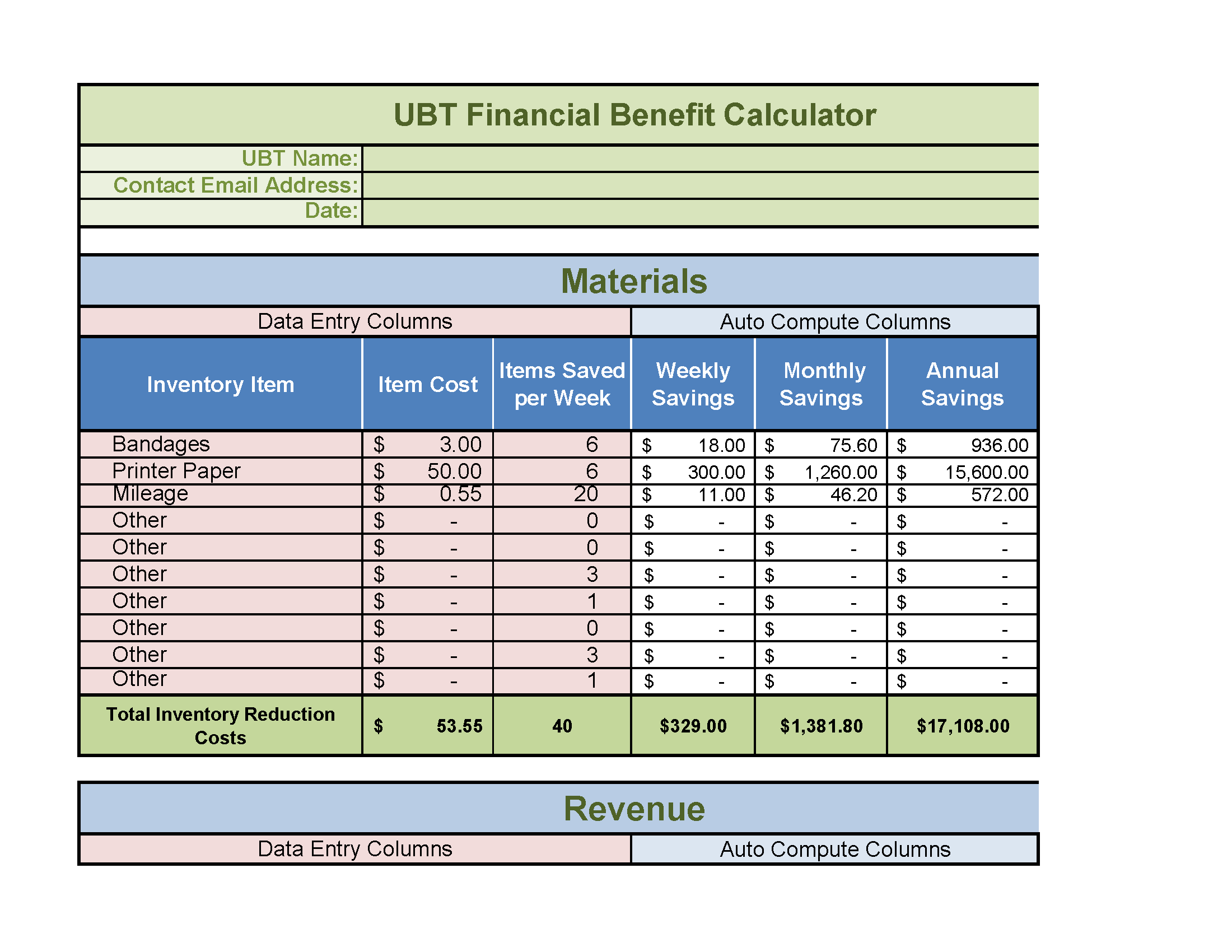
Handy Spreadsheet to Gauge UBT Savings

Format:
XLS (spreadsheet)

Size:
1 page

Intended audience:
UBT co-leads or team members

Best used:
Use this spreadsheet to track and determine the economic benefits of your team's performance improvement projects—you can easily see the impact of your efforts on the bottom line.

Note: Entries are placeholders; delete them and add your own information.


Related tools:

Health Care Reform Glossary

Deck: 
Key terms to know as you navigate the world of health care reform

Story body part 1: 

Affordable Care Act (ACA)

The comprehensive federal health care reform law enacted in March 2010.

Coinsurance

The percentage of charges a member pays when receiving a covered service. The member’s health plan coverage pays the balance up to the health plan’s allowance. Coinsurance amounts vary depending on the member’s plan and the service provided.

Copayment

The fixed dollar amount a member pays when receiving certain covered services or prescriptions. The member’s health insurance pays the rest. Copayments vary depending on the member’s plan and the service provided.

Cost share

The portion of charges for a service or prescription that the member is responsible for paying, such as a copayment, coinsurance or deductible payment.

Deductible

The fixed amount a member must pay in a calendar or contract year for certain health care services before the member’s health insurance begins to pay.

Dependent

A family member, such as a spouse, child or partner, who is covered under a policyholder or subscriber’s plan.

Federal financial assistance (subsidy)

Financial assistance in the form of reduced premiums and reduced out-of-pocket expenses to provide help for some people to pay for health coverage or care. The government will pay part of the premium and the out-of-pocket expenses directly to the health plan issuer. Usually determined by income level and family size.

Grandfathered plan

A group health plan that was created or an individual health insurance policy that was purchased on or before March 23, 2010. Grandfathered plans are exempted from many changes required under the Affordable Care Act.

Health care reform

A general term for the major health policy changes put in place by the federal Affordable Care Act of March 2010 and any state laws passed to put it in place.

Health Insurance Marketplaces

Government-run online markets, formerly called Health Insurance Exchanges, where individuals and small businesses will be able to compare and enroll in health plans, get answers to questions, and find out if they are eligible for financial assistance or special programs.

The marketplace

A common nickname for the Health Insurance Marketplaces, also called “exchanges.”

Medicaid

A government insurance plan for the poor and disabled; in California, it’s known as Medi-Cal.

Out-of-pocket expenses

These include the copayments, coinsurance and/or deductible payments members make for the health care services they receive, as opposed to the premium they pay each month to their insurers.

Pre-existing conditions

Medical conditions that a person has before he or she applies for a new health insurance policy.

Premium

The amount a member and/or the member’s employer pays, usually each month, for health care coverage.

Pages

Subscribe to RSS - LMP Processes