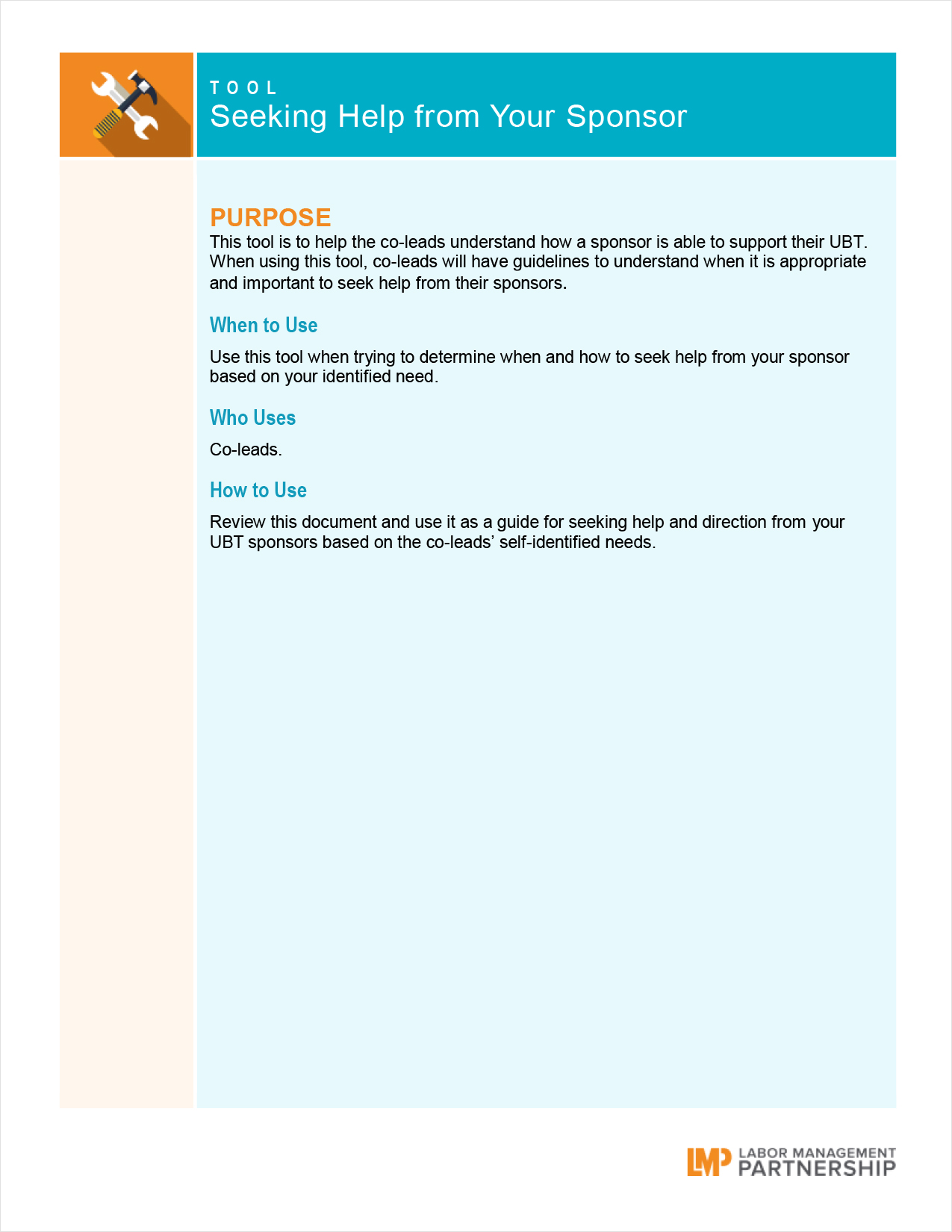
TOOLS
Seeking Help From Your Sponsor
Format:
PDF (color and black and white)
Size:
8.5" x 11"
Intended audience:
UBT co-leads
Best used:
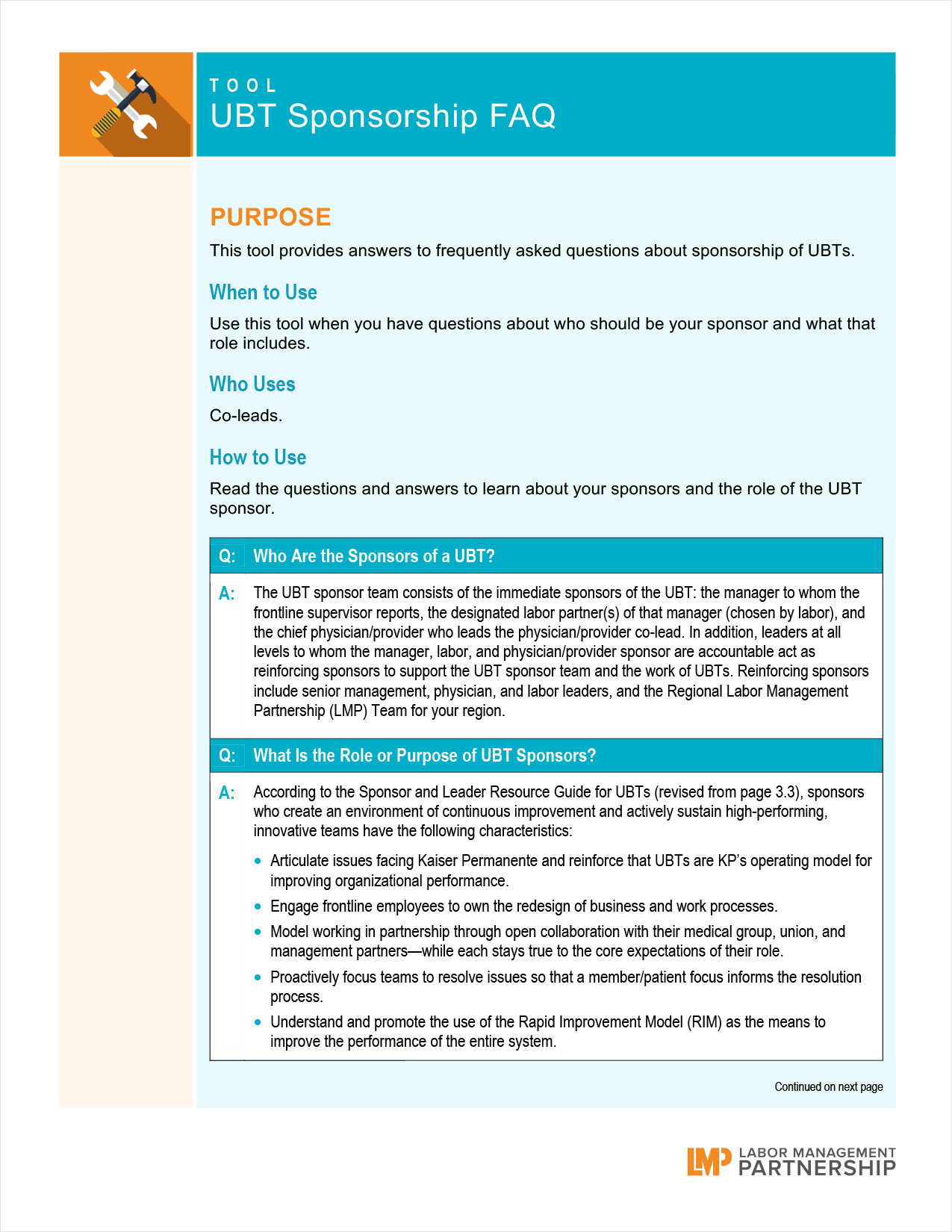
Use this tool as a guide to help you determine when and how to seek help from your team's sponsor.
Format:
PDF (color and black and white)
Size:
8.5" x 11"
Intended audience:
UBT co-leads
Best used:
Use this tool as a guide to help you determine when and how to seek help from your team's sponsor.
Format:
PDF
Size:
8.5" x 11"
Intended audience:
UBT co-leads
Best used:
This guide answers your questions about who should be your sponsor and what that role includes.
Format:
Word document
Size:
8.5" x 11"
Intended audience:
UBT sponsors
Best used:
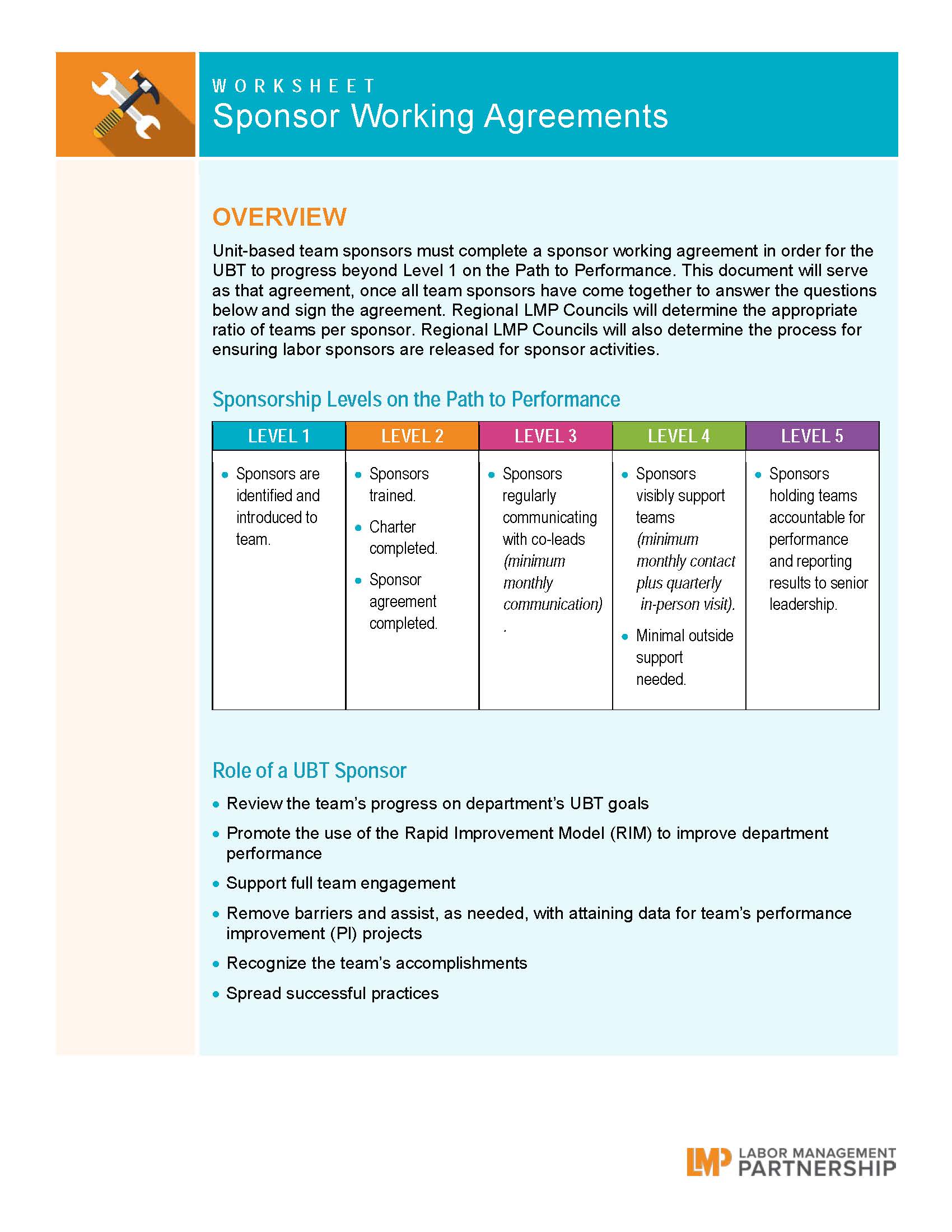
When you begin to work with a UBT, use these questions to help you and your co-sponsor(s) develop working agreements about how you will collaborate to support the team.
I am one of the chairs the LMP leadership team, along with a union colleague from UFCW and two management leaders. I’m also the co-lead of the Woodland Hills’ union coalition. In addition, I’m a full-time certified registered nurse anesthetist in the operating room. To be an effective labor co-lead takes three things: time, collaboration and planning.
I have been doing partnership work at Woodland Hills for 10 years. People respect the time I’ve invested. You have to be on fire for this because it’s an enormous responsibility. It’s going to cost you time, angst and effort. And you can’t build relationships passing in the hall. You have to make the investment of face time. That means showing up at the LMP council meetings, monthly, from 8:00 a.m. to noon.
It is important to bring in and plan for new blood. At Woodland Hills, we rotate the labor co-chair in our leadership team every two years. I believe this allows everyone to have a say. It builds trust and experience. And it ensures buy-in from each union—and each segment of each union. We build-in mentorship. For three months, the new person sits in and the current co-lead shows that person the ropes.
We also did this in the Kaiser Permanente Nurse Anesthetist Association when I was president in 2006. I would go with new facility reps to meetings.
We really foster union efforts at the medical center level. We’ve got a group of long-term union coalition people and our unions speak with a single, powerful voice. There have been issues between unions, and we had to work things out until cooler heads prevailed. People say ‘I’m sorry’ and move on.
Working with management is both easy and difficult. It’s easy because they are so partnership oriented and respectful of the unions, and they welcome input. They lead by influence—not by authority by virtue of where they are on the food chain—just like we do. It is difficult sometimes because it requires us to work hard as partners. Sometimes it would be easier to just go along with their recommendations, but then we wouldn’t really be doing our jobs as union leaders. At certain points, you have to say, ‘Well, let me think about that,’ and ask your constituents what they think.
Hospitals are traditionally very hierarchical. The partnership is such an opportunity to have a voice.
I have worked at Kaiser Permanente for 33 years, starting as a distribution worker in materials management. Being on the front lines helped me better understand the challenges staff face—and helped me, in my current role, see what it takes to spread and sustain change in a complex organization.
When we launched our first unit-based teams in 2007, I knew they could give our managers and teams a powerful tool for change. But to achieve their full potential, UBTs need the support of leaders at every level. In working with UBTs every day, I have found five practices that can help teams achieve their goals, and have helped me be a more effective leader.
I’m not a patient person by nature, and it took a visit to the world-class health care system in Jonkoping, Sweden, for me to see that it takes patience to sustain meaningful change. When you’re solving problems in a team-based workplace, real systemic change takes time. But it also takes hold deeper into the organization.
Spend time with a UBT, or hear teams present their test of change, to understand what they’re working on and how you can support them. There’s no way you can feel the excitement and energy from the team members and not feel proud and motivated by their work.
In Orange County—which has two large hospitals, in Irvine and Anaheim—we expect all teams to continually test and then spread their ideas and successful practices. We call it “One OC” and we talk about it all the time. You’re never going to achieve greatness globally if you don’t spread good work locally.
Early on we formed an Integrated Leaders group of senior labor and management leaders who meet monthly to monitor and assist our 107 UBTs. If a team is struggling, the IL group doesn’t descend on them and try to fix the problem. We provide tools and resources that help the team work through a problem and get results. For instance, we put together a UBT Start-up Toolkit with information on everything from setting up teams to finding training. We’re also looking at toolkits on fishbone diagramming, conducting small tests of change and providing rewards and recognition. And we’re asking how to make it easier for teams to access resources quickly—for instance by identifying go-to people for questions on budgeting, patient satisfaction metrics and so on.
I have a saying: “Hire great people, give them the coaching and mentoring they need, then get the heck out of their way and let them do what they were hired to do.” I think that works at all levels of the organization, whether or not people are your direct hires. You don’t tell people to make a change or streamline a process without any encouragement or support, but you don’t need to micromanage them either. Delivering great health care is not just a job. It is a calling. Whether you’re a housekeeper preventing infection or a surgeon treating cancer, people’s lives are in our hands. That shared mission drives us to be the best.
Formats:
Word document, PDF
Size:
8.5" x 11"
Intended audience:
UBT co-leads
Best used:
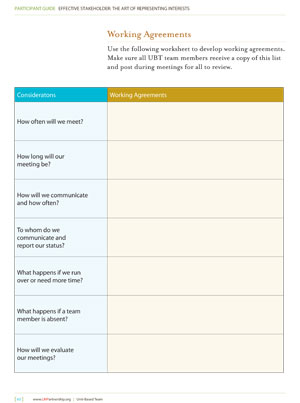
This worksheet can help you and your co-leads craft successful working agreements to plan, run and evaluate meetings.
Format:
GIF, one-color (black)
Best used:
This small file format uses the minimum amount of information possible. Use it for web and multimedia such as PowerPoint presentations. The .gif format provides the option of saving with transparent background. You can also use it for simple animations on the web.
Format:
PDF
Size:
8.5" x 11"
Intended audience:
Co-leads
Best used:
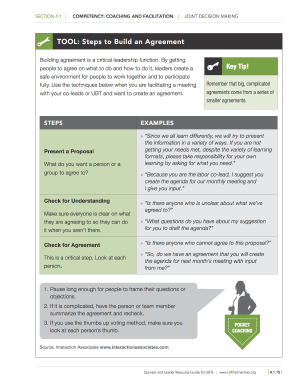
Building agreement is a critical leadership function. This table suggests techniques you can use when you are facilitating a meeting with your co-leads or UBT and want to create an agreement.
How we bargain our National Agreements is as important as what we bargain. We use an interest-based problem-solving approach. This is a collaborative approach to solving problems that strives to meet the most critical needs of all parties. It also aims to preserve — and improve — workplace relationships and partnership. It’s not about “giving in,” but rather is a process to negotiate differences amicably and reach results that will be lasting and durable.
Traditional, adversarial bargaining usually begins with each side staking out its position. In contrast, interest-based bargaining begins with all parties discussing what their needs are. Both parties work on an issue together, explore options and find a solution that meets the key interests. That sense of shared ownership smoothes the way for successfully implementing the agreement. This approach also opens the door to collaborative problem solving — as opposed to competition or compromise — and leads to creative, mutually beneficial solutions.
Interest-based bargaining works best when both sides share information, focus on key issues, listen actively, are open to different options and trust one another. We’ve found that this approach addresses the needs of union members and helps the organization improve performance — which ultimately benefits our health plan members and the communities we serve.
Learn more about the 2015 Coalition National Agreement and the 2018 Alliance National Agreement.

 A Step-by-Step Guide
 How Our Bargaining Works
 Getting to Thumbs Up
 Interest-Based Harmony