Kaiser Permanente and the Alliance of Health Care Unions

Program-wide

Bargaining Timeline: Optimized for The Realities of 2021

Story body part 1: 

The Common Issues Committee (CIC), the full bargaining team that negotiates national agreements, is scheduled to meet for 5 separate sessions between April and September.  Most sessions will be conducted virtually via videoconferencing, due to ongoing restrictions associated with COVID-19.  However, in-person meetings are planned for August and September.

BARGAINING SESSION

DATES

LOCATION

Kickoff meeting

Introductions

Training in interest-based process

April 20-21

Virtual

Bargaining

Check-in 1

CIC updated on subcommittees’ progress

June 23

Virtual

Bargaining

Check-in 2

CIC updated on subcommittees’ progress

August 4

Virtual

Session 1

In-person session

August 31-September 2

Southern California

Session 2

In-person session

September 8-10

Southern California


Bargaining Subcommittees

Story body part 1: 

Four subcommittees, made up of representatives chosen by KP and union leaders, will examine issues of importance to labor and management.  This year, those topics include problem and dispute resolution; staffing, backfill, and the use of travelers; patient and worker safety; and racial justice.

Each subcommittee is led by a management and union representative. Instead of taking hardline positions, subcommittee members stake out common interests. During the course of bargaining, assisted by outside facilitators, they identify interests and develop options.

Subcommittees will report on their progress at key “check-in” meetings with the Common Issues Committee (CIC) in June and August.

The four subcommittees and their co-leads are:

Problem and Dispute Resolution

  • Management co-lead: Eric Ruperto
  • Alliance co-lead: Julie Kwiek 

Staffing, Backfill and Travelers

  • Management co-leads: Aileen Oh and Jerry Spicer
  • Alliance co-leads: Jodi Barschow and Peter Sidhu

Patient & Worker Safety

  • Management co-lead: Maria Dee
  • Alliance co-lead: Charmaine Morales 

Racial Justice

  • Management co-lead: Laura Long
  • Alliance co-lead: Sandra Flores

National Bargaining Between KP and the Alliance Begins

Deck: 
Virtual kickoff sets the stage for arriving at a second national agreement

Story body part 1: 

Kaiser Permanente and the Alliance of Health Care Unions kicked off national bargaining on April 20 under a streamlined virtual format driven in part by the COVID-19 pandemic.

Bargaining sessions are scheduled to run through September and will involve more than 100 management and labor representatives from across the organization. This marks the second time that KP and the Alliance have negotiated a national contract since the Alliance, which comprises 22 local unions, formed in 2018. The current national agreement expires September 30, 2021.

A different bargaining experience

Like so much else during the pandemic, this bargaining year differs significantly from the past. Most sessions will be held virtually, with in-person meetings scheduled for late August and September.

In addition, the number of bargaining sessions has been reduced from 30 sessions in 2018 to 14 for 2021. During those sessions, subject matter experts chosen by management and labor will form subcommittees to address specific topic areas. This year, those topics include problem and dispute resolution; staffing, backfill, and the use of travelers; patient and worker safety; and racial justice.

Hal Ruddick, executive director of the Alliance, said the Labor Management Partnership is more important than ever as both parties seek new ways to work together in a difficult health care environment.

“The pandemic has been difficult for all of us, especially our frontline health care workers,” said Ruddick. “We’re looking forward to upholding our partnership commitment to the best jobs and the best performance to prepare for future challenges.”

Interest-based bargaining

The Alliance represents almost 50,000 workers enterprisewide, nearly half of whom are represented by United Nurses Associations of California/Union of Health Care Professionals. Under the 2018 Labor Management Partnership Agreement, KP and the Alliance agreed to work collaboratively to improve the quality of care for members and communities and help KP lead the market in health care — while preserving industry-leading benefits and working conditions for employees.

Steve Shields, senior vice president of National Labor Relations and Office of Labor Management Partnership, said he looks forward to negotiating a new agreement with the Alliance.

“I’m excited to be involved in national bargaining this year and to use an interest-based process that has served Kaiser Permanente and its labor partners so well over the years,” said Shields.

Unlike traditional bargaining where each side takes an adversarial position, interest-based bargaining calls for the parties to identify common issues of concern and work collaboratively to achieve mutually beneficial solutions. The process helps labor and management maintain a respectful and constructive relationship while creating a deeper commitment to the final agreement.

Hank: Equity for All

Story body part 1: 

Check out this immersive, multimedia online version of Hank magazine, powered by Issuu. 

Empowering the Workforce

Deck: 
Education and training programs expand opportunities for career growth

Story body part 1: 

The training and education resources negotiated by Kaiser Permanente and the Partnership unions are helping employees advance their careers. These opportunities are making KP’s promise of a diverse and inclusive workplace come to life. Learn more from employees, managers and leaders who shared their stories during the first virtual Workforce Development Week.

Addie Darby, UFCW Local 1996, quality control, Health Information Management, Georgia

With the help of the Ben Hudnall Memorial Trust and encouragement of manager Sophia Wilson, Darby has earned an associate degree in business management, a bachelor's in health administration, and a master's in health technology and education. She’s not stopping there. Darby is enrolled in a doctorate program and plans to graduate this year (2021).

Sadao Nakachi, UNAC/UHCP, emergency room nurse, Southern California

After leveraging workforce development opportunities to become an RN and earn a bachelor’s degree in nursing, Nakachi went on to get a master’s in business for veterans. He holds numerous professional certifications and connects fellow nurses to educational opportunities. “I always try to find courses that’ll overall maximize my potential at KP,” he says. Follow him on Instagram @NurseScholar.

Crystal Muir, OPEIU Local 2, clinical assistant, Mid-Atlantic States

Muir is using tuition reimbursement to pursue her bachelor’s degree in nursing. She’s also used the Ben Hudnall Memorial Trust’s Individual Stipend Program to attend school once a week, which she says, “I've been fortunate to do with trying to balance school, work and life being a mom.” She aims to graduate in 2022.

Sophia Wilson, supervisor, Health Information Management, Georgia

“I encourage all my staff to pursue education to stay marketable and relevant,” Wilson says. “I tell managers, ‘Please do not be so rigid as to make it harder for your employees to soar.’ If you put the resources into your staff, it can be nothing but a win-win.”

Philidah Seda, director, Specialty Care, Georgia

Not only does Seda encourage her staff to use workforce development resources, but she herself is studying for her doctoral degree. “The health care environment is getting more and more complex,” she says. “For us to prepare the workforce of the future, we have to invest in their learning.”

Eula Smith, SEIU-UHW, medical assistant, Northern California

Ask Smith why she wanted to work in health care, and she will bluntly tell you she didn’t. She started at KP as a shuttle bus driver. When that department was outsourced, Smith was offered the opportunity to train as a medical assistant with the help of the SEIU UHW-West & Joint Employer Education Fund. She has overcome her initial reluctance to deal with patients, saying “I love it now.”

Ingris Solares, SEIU Local 105, medical lab technician, Colorado

Solares began her career at KP as a phlebotomist before getting trained in her current field in an apprenticeship program with the help of SEIU Local 105 and the SEIU UHW-West & Joint Employer Education Fund. She intends to get more education to become a clinical lab scientist. “I knew I wanted more because I'm the first generation here in the United States,” she says. “My parents came from Guatemala, so I always felt like I needed to make the trip here worth it.”

Michael Brown, senior vice president, HR Consulting, National Functions

Before embarking on a career path that would bring him to KP as an HR leader, Brown went to law school. His father was frank with him: As a Black man, he needed an advanced degree to position himself for the same opportunities that others had.

“Before I even started working, I knew that education was going to be the equalizer.” That’s why he encourages KP employees to use workforce development programs and cultivate learning agility by trying different shifts, joining different departments and seeking informal leadership roles.

Kerrin Watkins, manager, Dental Office, Northwest

It's hard to lose top performers, but amazing to see them grow. “Invest in your employees and let them know you want to see them succeed,” Watkins says. “This will benefit you in the long run, because you will have employees that will feel more valued. If you take care of your employees, your employees will take care of your business.”
 

TOOLS

Health and Safety Champions — April 2021 Focus

Format:
PDF

Size:
One page, 8.5" x 11"

Intended audience:
UBT health and safety champions

Best used:

Partner with your teammates to identify and reduce the risk for workplace conflict.

Related tools:

TOOLS

Health and Safety Champions — March 2021 Focus

Format:
PDF

Size:
One page, 8.5" x 11"

Intended audience:
UBT health and safety champions

Best used:
Help your teammates design healthy intentions to restore their mind, body, and spirt.

Related tools:

TOOLS

Glossary: The Building Blocks of Partnership

Format:
PDF

Size:
2 pages, 8.5” x 11”

Intended audience:
Members and leaders of unit-based teams

Best Used:
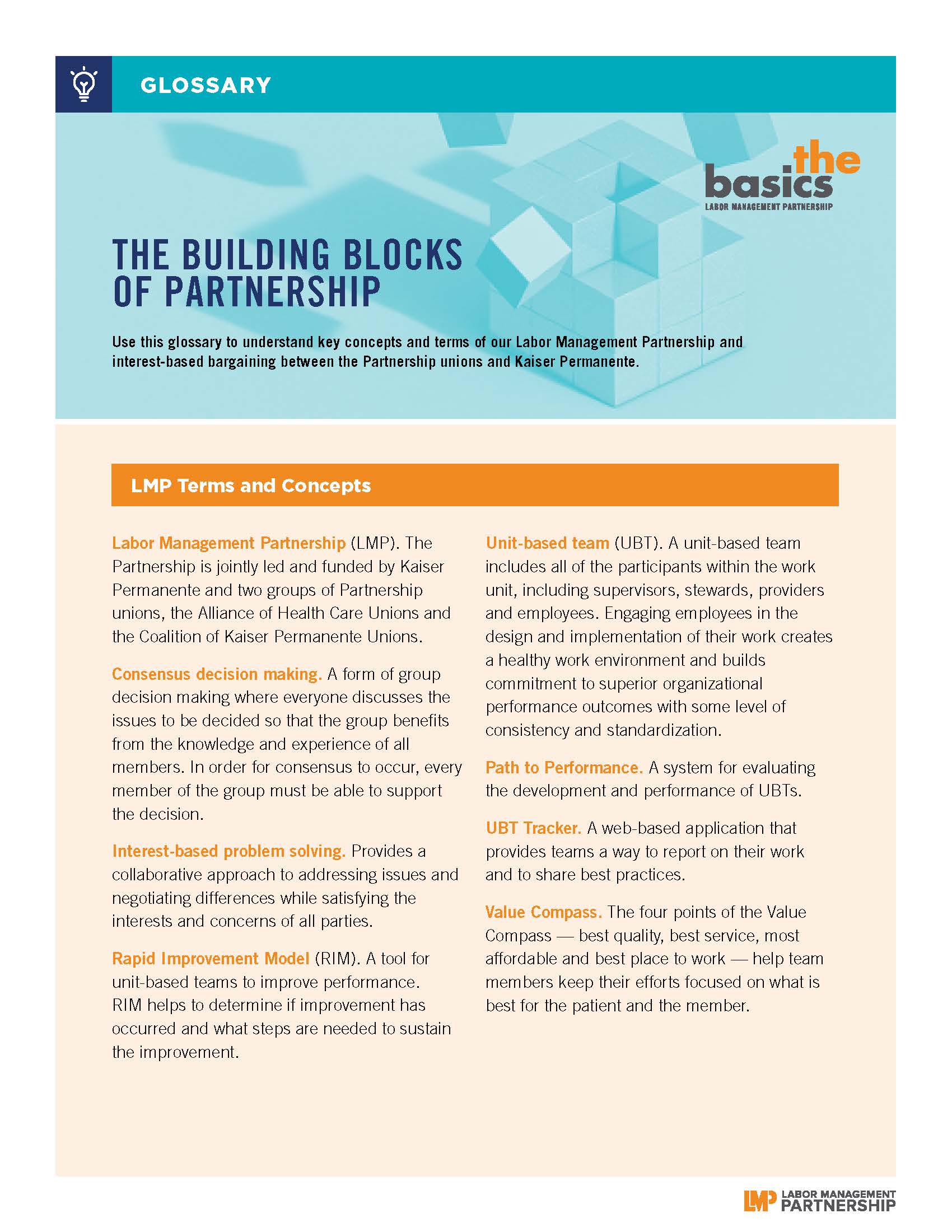
Use this glossary to understand key concepts and terms related to the Labor Management Partnership and interest-based bargaining.

Related tools:

Pages

Subscribe to RSS - Program-wide