Kaiser Permanente and the Alliance of Health Care Unions

National Leaders

Bargaining Timeline: Optimized for The Realities of 2021

Story body part 1: 

The Common Issues Committee (CIC), the full bargaining team that negotiates national agreements, is scheduled to meet for 5 separate sessions between April and September.  Most sessions will be conducted virtually via videoconferencing, due to ongoing restrictions associated with COVID-19.  However, in-person meetings are planned for August and September.

BARGAINING SESSION

DATES

LOCATION

Kickoff meeting

Introductions

Training in interest-based process

April 20-21

Virtual

Bargaining

Check-in 1

CIC updated on subcommittees’ progress

June 23

Virtual

Bargaining

Check-in 2

CIC updated on subcommittees’ progress

August 4

Virtual

Session 1

In-person session

August 31-September 2

Southern California

Session 2

In-person session

September 8-10

Southern California


Bargaining Subcommittees

Story body part 1: 

Four subcommittees, made up of representatives chosen by KP and union leaders, will examine issues of importance to labor and management.  This year, those topics include problem and dispute resolution; staffing, backfill, and the use of travelers; patient and worker safety; and racial justice.

Each subcommittee is led by a management and union representative. Instead of taking hardline positions, subcommittee members stake out common interests. During the course of bargaining, assisted by outside facilitators, they identify interests and develop options.

Subcommittees will report on their progress at key “check-in” meetings with the Common Issues Committee (CIC) in June and August.

The four subcommittees and their co-leads are:

Problem and Dispute Resolution

  • Management co-lead: Eric Ruperto
  • Alliance co-lead: Julie Kwiek 

Staffing, Backfill and Travelers

  • Management co-leads: Aileen Oh and Jerry Spicer
  • Alliance co-leads: Jodi Barschow and Peter Sidhu

Patient & Worker Safety

  • Management co-lead: Maria Dee
  • Alliance co-lead: Charmaine Morales 

Racial Justice

  • Management co-lead: Laura Long
  • Alliance co-lead: Sandra Flores

National Bargaining Between KP and the Alliance Begins

Deck: 
Virtual kickoff sets the stage for arriving at a second national agreement

Story body part 1: 

Kaiser Permanente and the Alliance of Health Care Unions kicked off national bargaining on April 20 under a streamlined virtual format driven in part by the COVID-19 pandemic.

Bargaining sessions are scheduled to run through September and will involve more than 100 management and labor representatives from across the organization. This marks the second time that KP and the Alliance have negotiated a national contract since the Alliance, which comprises 22 local unions, formed in 2018. The current national agreement expires September 30, 2021.

A different bargaining experience

Like so much else during the pandemic, this bargaining year differs significantly from the past. Most sessions will be held virtually, with in-person meetings scheduled for late August and September.

In addition, the number of bargaining sessions has been reduced from 30 sessions in 2018 to 14 for 2021. During those sessions, subject matter experts chosen by management and labor will form subcommittees to address specific topic areas. This year, those topics include problem and dispute resolution; staffing, backfill, and the use of travelers; patient and worker safety; and racial justice.

Hal Ruddick, executive director of the Alliance, said the Labor Management Partnership is more important than ever as both parties seek new ways to work together in a difficult health care environment.

“The pandemic has been difficult for all of us, especially our frontline health care workers,” said Ruddick. “We’re looking forward to upholding our partnership commitment to the best jobs and the best performance to prepare for future challenges.”

Interest-based bargaining

The Alliance represents almost 50,000 workers enterprisewide, nearly half of whom are represented by United Nurses Associations of California/Union of Health Care Professionals. Under the 2018 Labor Management Partnership Agreement, KP and the Alliance agreed to work collaboratively to improve the quality of care for members and communities and help KP lead the market in health care — while preserving industry-leading benefits and working conditions for employees.

Steve Shields, senior vice president of National Labor Relations and Office of Labor Management Partnership, said he looks forward to negotiating a new agreement with the Alliance.

“I’m excited to be involved in national bargaining this year and to use an interest-based process that has served Kaiser Permanente and its labor partners so well over the years,” said Shields.

Unlike traditional bargaining where each side takes an adversarial position, interest-based bargaining calls for the parties to identify common issues of concern and work collaboratively to achieve mutually beneficial solutions. The process helps labor and management maintain a respectful and constructive relationship while creating a deeper commitment to the final agreement.

Decreasing Diabetes Disparaties

Deck: 
Personalizing care improves outcomes for Latino patients

Story body part 1: 

When it comes to addressing health care disparities, medical office assistant Anna Jenkins thinks her unit-based team is up to the challenge. 

“I can go to my UBT members and say, ‘This is a care gap. Give me your feedback. Give me your ideas,’” says Jenkins, an OPEIU Local 30 member and labor co-lead for the Rancho San Diego Primary Care team. “Our administration listens to us. They’re very open to letting us try it our own way.” 

The Level 5 team is leveraging Labor Management Partnership principles and tools to communicate, coordinate and customize care for Latino patients with diabetes. The approach has led to better health outcomes and improved service for a group disproportionately impacted by diabetes. 

The unit-based team has increased the number of Latino patients ages 65 to 75 whose blood sugar levels are under control, according to recent clinical quality measures. 

“That partnership between management and labor is important,” says Silvia Hernandez, RN, medical office administrator and the team’s management sponsor. “This teamwork helps us to improve patient care and quality with excellent member satisfaction.” 

Adapting approaches 

Key to the team’s success is partnering with Complete Care Management, a specialized strike force that monitors the health of patients who struggle to control chronic conditions, such as diabetes and high blood pressure. 

To better support her Latino patients, care manager Lily Thamiz, RN, has adapted her approach. She books longer appointments  for Spanish-speaking patients who need interpreters, refers others to bilingual diabetes education classes, and relies on phone calls to connect with those short on time. 

“The only time we can talk is when they’re driving,” says Thamiz, a member of Specialty Care Nurses of Southern California, an affiliate of UNAC/UHCP. “These are solutions I’d never considered before.” 

UBT members tailor treatment in other ways, too. To ensure continuity of care for Latino patients in their 60s and 70s, they standardized the steps needed to download and share data from glucose monitors. Providers use the devices to track patients’ blood sugar levels and adjust their medications. By consistently managing and sharing data, staff members guarantee they do not miss crucial patient information when communicating with one another. 

“They make you feel like you really matter,” says Mary Hart, 71, a Latina patient who has diabetes. “They really show their concern for your health.”

Equity for All

Deck: 
Teams answer the call to address care gaps

Story body part 1: 

“Everyone must put on their leadership hat. It doesn’t relate to title or overall responsibility —  it’s what you control and influence from where you stand,” said Ronald Copeland, MD, senior vice president and chief equity, inclusion and diversity officer, at the National Equity, Inclusion, and Diversity Virtual Conference Series in October.

The Labor Management Partnership is designed to foster leaders at every level, to encourage everyone to use their voice and add their ideas to solving the challenges at hand. As our nation and our organization seek new ways to advance equity and diversity — including equity in health care — doing the right thing has never been more important.

“Action matters more than passion, and impact matters more than intent,” Dr. Copeland said. “It’s great to say, ‘I want everybody to achieve equity and inclusion,’ but we have to do the actions that make that occur.”

See equity in action in this issue of Hank with inspiring actions taken by 4 unit-based teams from across the organization. Together, their commitment to achieving equitable outcomes in maternal-child health, and in treating diabetes and high blood pressure, is reshaping what culturally sensitive care looks like for thousands of our members and patients.


Strength in Partnership

Deck: 
Labor and management collaborate to address pandemic

Story body part 1: 

In 1997, the Labor Management Partnership turned strife between Kaiser Permanente and its unions into strength.

That strength is coming to the forefront again today. Decades of working in partnership are helping the organization respond to the COVID-19 pandemic, move forward together and provide a model for the health care industry.

With interest-based problem solving, a Free to Speak culture and performance improvement through unit-based teams, the Partnership has built a foundation that’s given leaders, managers and union members tools and relationships to collaboratively address this crisis.

Acting fast

Some of the response took place at the highest levels. Over a weekend, Kaiser Permanente and union leaders reached an agreement to temporarily enhance benefits for physicians and frontline employees.

“I’ve never negotiated anything as fast,” says Dennis Dabney, senior vice president of National Labor Relations and the Office of Labor Management Partnership.

Throughout the crisis, union leaders joined twice-weekly calls with top Kaiser Permanente leaders and played a central role with command centers and surge planning.

The key to making faster decisions was directly involving labor in operations meetings, says Hal Ruddick, executive director for the Alliance of Health Care Unions.

Having a voice

Partnership laid the groundwork for a nimble response in other ways, too. When COVID-19 hit, most vision appointments were canceled.

In Northern California, IFPTE/ESC Local 20 negotiated with management to have optometrists work in different roles. More than 120 optometrists volunteered to staff the COVID-19 test results call-in line.

“We showed our willingness to do alternative work — work that would be meaningful and keep our union members safe,” says optometrist John Corpus, a member of the local union’s optometry unit board.

Having a voice on the job equipped members to negotiate that deal, which included training, laptops and greater flexibility to work remotely.

“If our teams remain safe, are listened to and feel respected in the changes, they can live with the changes during this time,” Corpus says.

Improving workflows

At Beaverton Medical Office in Oregon, after COVID-19 testing began, managers saw that patients often needed multiple services. A new workflow was required — and the Nurse Treatment Room team’s registered nurses and medical assistants rose to the challenge.

“Everyone began sharing ideas and brainstorming possible solutions,” says nurse manager Cyndy Gillis. “The team formulated a plan that respected scope of practice, safety for the staff and patients, and a streamlined workflow that continues to adjust to new challenges.”

“It was the epitome of collaboration,” says team member Kellie Butchino, a certified medical assistant and SEIU Local 49 member.

Fighting together

One of the most vexing problems during the pandemic has been getting caregivers the personal protective equipment they need to safely care for patients. Working in partnership has helped.

“It’s not perfect,” says UNAC/UHCP member Andrew Calderon, a physician assistant at South Bay Medical Center in Southern California.

“But labor and management were there updating staff regularly and fighting to get us the materials we needed.

“We are able to provide the best care for our members because of partnership.”

Looking forward

Such collaboration across the enterprise will help Kaiser Permanente navigate the future — and inspire others, too.

In May, LMP leaders shared their pandemic experiences during a Labor and Employment Relations Association webinar, drawing praise from members of a 4-year-old labor- management partnership in Massachusetts.

“We are trying to proceed on the premise that there is no business case for adversarial labor relations,” says Bart Metzger, chief human resources officer for UMass Memorial Health Care. Partnership is “the only way we can push organizations such as ours forward.”

Partnership is an effective strategy for labor and management, Ruddick says.

“It’s harder, but it’s worth it because the results that you get are better.”
 

TOOLS

LMP Vision: Reaffirmation and Understandings

Format:
PDF

Size:
8.5” x 11” (29 pages)

Intended audience:
Anyone interested in LMP principles and their history

Best used:
This pamphlet sheds light on the issues the Labor Management Partnership faced during its first 5 years. It outlines the findings that came an important round of discussions in 2002, when union and Kaiser Permanente leaders reaffirmed that putting the LMP vision into practice was essential to the future of the organization.


Related tools:

TOOLS

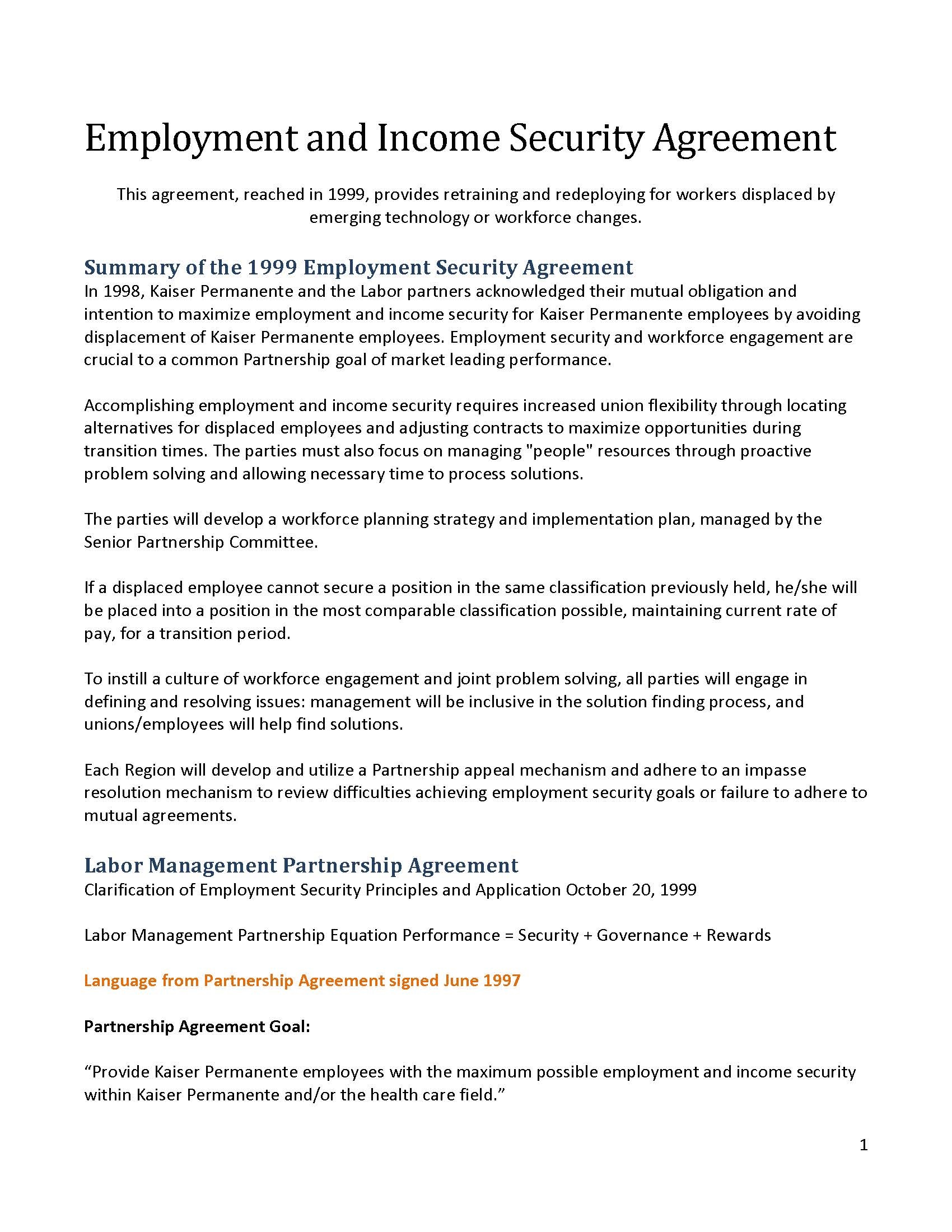
Employment and Income Security Agreement

Format:
PDF

Size:
6 pages

Intended audience:
Employees, managers and leaders at all levels interested in the Employment and Income Security Agreement. 

Best used:
Download when you need a printer-friendly PDF of the agreement. The agreement is also available online

Related tools:

Pages

Subscribe to RSS - National Leaders